coral traits
Trait choice and selection key to helping corals survive heatwaves
Published on: 17 April 2026
Assisted evolution could help corals survive future heatwaves, but careful trait choice and strong repeated selection will be needed for it to be effective.
As global temperatures rise, marine heatwaves are becoming more frequent and severe, driving coral bleaching and mortality. While some coral populations are already showing signs of natural adaptation, researchers warn that these changes are unlikely to keep pace with future warming.
A new study published today (17 April) in Current Biology explores whether host assisted evolution, which aims to accelerate natural adaptation rates of corals, could help them survive future heatwaves and what it would take to achieve required tolerance gains.
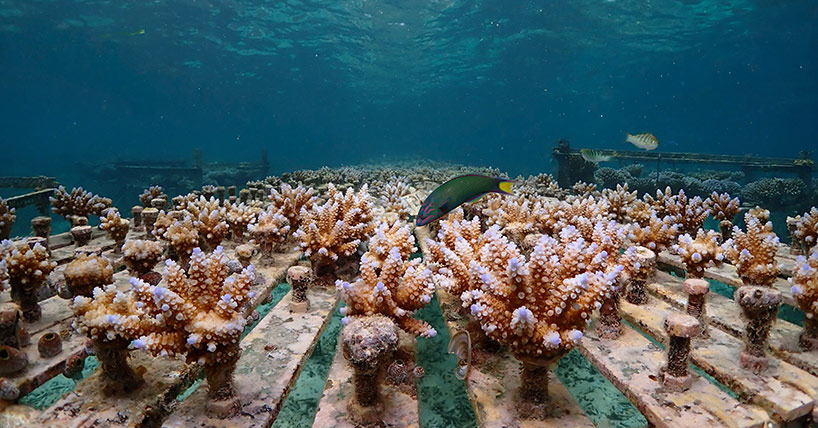
The international research team, led by Newcastle University, have created a unique, pedigree-tracked coral population over the last eight years, allowing them to map family relationships and measure how multiple key traits—such as growth, reproduction and survival—are inherited.
By combining information on multiple traits for each coral, their family relationships and advanced statistical modelling, the scientists were able to estimate each coral’s genetic merit for heat tolerance and other traits, and the genetic links among traits, insights that go beyond what can be simply observed.
Dr James Guest, Reader in Coral Reef Ecology at Newcastle University and the principal investigator of the project supporting this study, said: “Developing and maintaining this pedigree-tracked coral population has driven a step change in our ability to identify which traits to select for to enhance tolerance under future climate stress. Being able to produce corals from parental colonies with known histories and well-characterised traits—and then observe how this genetic information influences offspring performance—has significantly advanced our understanding of how assisted evolution can be effectively implemented to conserve coral reefs.”
The results show that assisted evolution methods targeting the coral host—rather than its symbionts—will require choosing the right traits and repeatedly selecting corals over multiple generations to strengthen those traits.
Selection must directly target long-term heatwave survival, or traits that have a strong genetically based correlation to heatwave survival. To keep pace with climate change, efforts will need to implement very strong selection, choosing the top 1-5% most tolerant corals as broodstock. And this process will have to be repeated over multiple generations to achieve desired evolutionary benefits. Such intense selection introduces other challenges, including the maintenance of genetic diversity and practicality of scaling up selection efforts.
Study lead author, Dr Liam Lachs, a former Postdoctoral Research Associate at Newcastle University’s School of Natural and Environmental Sciences and current Research Fellow at University of Queensland, Australia, said: “Local adaptation involves more than just heat tolerance. Traits like growth, reproduction, calcification, tissue biomass, and symbiont flexibility all contribute to overall fitness. If improving heat tolerance came at the cost of these traits, it could undermine population viability. But encouragingly, we found no detectable negative genetic correlations among any traits; good news for assisted evolution interventions.”
Not a silver bullet
The researchers stress that assisted evolution is not a substitute for cutting greenhouse gas emissions, which remains essential to limit ocean warming.
However, as global mitigation efforts continue, targeted local interventions could play an important supporting role at certain scales. Strategic conservation approaches, including assisted evolution, may help key coral species adapt and persist in a rapidly changing climate.
Study lead author, Dr Adriana Humanes, a Research Associate at Newcastle University, said: “Our results show that increasing coral heat tolerance can, in principle, deliver meaningful gains for coral persistence. But success will depend on choosing the right traits and strong, sustained selection. While reducing greenhouse gas emissions is still the main priority to mitigate the warming corals face, other mitigation efforts such as assisted evolution will be crucial to help key species adapt and persist in our rapidly warming world.”
Reference
Lachs, L., Humanes, A., Guest, J. R., et al. (2026). Choice of traits defines the scope for assisted evolution of corals under climate change. Current Biology. https://doi.org/10.1016/j.cub.2026.03.055