Mathematics PhD student represents Newcastle at STEM for Britain 2026
1 May 2026
In March, Mathematics PhD student Jamie McKeown won a place to attend the Parliamentary and Scientific Committee’s STEM for Britain competition, held at the Houses of Parliament. Here, Jamie tells us about his research and the reason he chose to study at Newcastle University.
Tell us about your research project
My research project is on developing mathematical models of the spread of invasive pests, especially tree pests. I use partial differential equations (PDEs) to describe how the pest's population varies in space and time according to the physical processes they undergo, such as dispersal and reproduction, which are encoded as parameters of the equations. These equations are usually challenging/impossible to solve by hand, so we use GPU-accelerated numerical methods to produce accurate approximations of the solutions to these equations quickly.
Utilising real world data on the pest's spread, I determine which parameters best fit the data using Bayesian inference; we draw possible parameters from distributions, solve the equation for these parameters, and compare the PDEs solution to the data to determine how well the true spread is captured by these parameters given the data. While I've mostly worked on modelling the invasive oak processionary moth, my framework is applicable to a wide-range of invasive species — currently I am working on applying the framework to model the spread of muntjac deer in the UK.
Why did you choose to study at Newcastle University?
I grew up in Gateshead and wanted to stay local when choosing where to go for university. I graduated from Newcastle University with a Mathematics MMath in 2019. When I came to look for PhD projects, I wanted to return to Newcastle University; the academics in the School of Mathematics, Statistics and Physics are highly motivated and passionate about their work, so it was an easy choice to stay!
Although my interest as an MMath student had been in Pure Mathematics, as I started my PhD journey I became more interested in other areas. I saw a project advertised on collective behaviour and invasive tree pest spread which sounded interesting, so I applied. The project was offered through the ONE Planet Doctoral Training Programme, which spans areas including Climate Change and Environmental Informatics. This gave me access to a generous funding package and training regime, allowing me to get the most out of the PhD experience.
Why did you decide to enter the STEM for Britain competition?
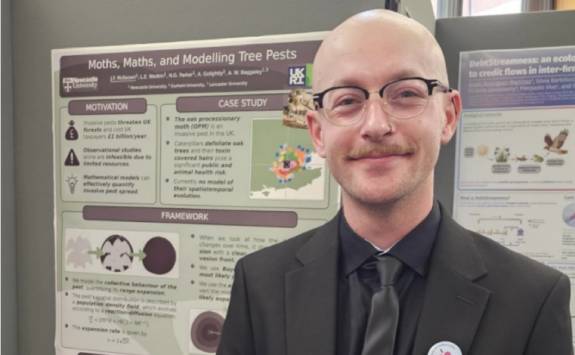
I love maths and talking about maths, and my supervisors thought I communicated my work well. One of my supervisors, Laura Wadkin, had previously taken part in STEM for Britain and encouraged me to apply as she found the experience very rewarding. I enjoy designing posters and presentations, and STEM for Britain is one of the most prestigious events you can present a poster at.
What was your experience of the day?
We spent the day in Portcullis House (one of the main parliament buildings). The first portion of the day gave finalists a chance to network and look at other competitors’ posters. I got to hear about some very interesting topics in Mathematics, Chemistry, and Engineering, and make connections with fellow Early Career Researchers. This was followed by a formal judging session. The judging was fairly relaxed – two judges visited my poster, during which I presented a 3 minute “mini talk” on my research, intended to be aimed at an interested non-specialist. The judges were very encouraging and asked lots of useful questions.
After this, we had lunch with competition sponsors while the judges deliberated. I had a chance to speak to senior employees at various scientific institutes in the UK, talk about my research with them, and hear about some of the work they've been doing. It was a fantastic opportunity to hear about what STEM looks like outside of academia in the public and industry sectors. We were also visited by our MPs who were very interested in hearing about the work we are doing; I had the pleasure of meeting both my work and home MPs and to discuss my research with them! We then attended the award ceremony. Although I wasn’t chosen as a winner, being selected as a finalist and invited to present my work was a real achievement in my academic career.
What advice would you give to other Early Career Researchers on how to communicate their high-level research to non-specialists?
Everybody loves pictures and graphs! They’re useful for conveying a lot of information and for helping people to recognise patterns. Maths is a challenging one because it's often a lot of complicated equations or long-winded calculations, so finding analogies between your work and things in everyday life can be helpful.
Finally, practice – particularly with people in your life who don't know much about maths or science. As you get a feel for which explanations are effective (and which aren't), you'll figure out the best way to communicate your work.