
Which Health & Science Path Is Right for You?
Choosing a degree in health or science starts with knowing what interests you and where you see your future taking you. Here’s a look at the paths that could be right for you.
20 October 2026
Interested in diagnosing and treating health conditions?
If you enjoy working with people, communicating, solving problems, and applying science to individual patients, an MBBS could be the right fit for you.
Medical students learn about the human body, diseases, and their treatment, while developing the clinical knowledge and practical skills needed to care for patients. As they progress through their training, they gain exposure to different areas of medicine and learn how to apply their knowledge in real clinical environments.
A career in medicine can be demanding, but it can also be rewarding. Every day brings opportunities to work with people, make clinical decisions, and contribute directly to their health and wellbeing.

Interested in the science behind health and disease?
If you are always asking “Why does this happen?”, Biomedical Sciences may be worth exploring.
Biomedical Sciences looks more deeply into the science that underpins human health and disease. You may study areas such as molecular biology, genetics, neuroscience, physiology, and disease mechanisms.
Rather than focusing primarily on treating individual patients, biomedical scientists investigate the processes that cause disease, how the body responds to illness, and how new approaches to diagnosis, prevention and treatment can be developed.
This can lead to careers in research, biotechnology, pharmaceuticals, diagnostics, healthcare, academia, and other scientific fields.

Interested in how movement and exercise shape health and performance?
If you are fascinated by how the body responds to exercise, how physical activity can support health, or what helps people perform at their best, Sport & Exercise Science could be the right fit for you.
Sport & Exercise Science explores the relationship between anatomy, physiology, nutrition, psychology and biomechanics. Instead of focusing primarily on treating disease or studying it at a molecular level, Sport & Exercise Science seeks to understand the effects of physical activity and exercise on health, fitness, and human performance.
As a Sport & Exercise Science graduate, you may work alongside other healthcare and health-related professionals, such as dietitians and nutritionists, as well as athletes, coaches, and performance teams to optimise training, recovery, and rehabilitation strategies.
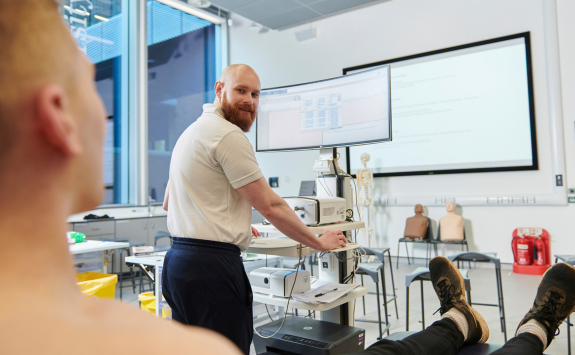
Interested in using data to solve health problems?
If you are interested in using data to understand health, support clinical decision-making, and address biomedical challenges, Data Science could be a strong fit.
Students first develop a strong quantitative foundation in areas such as statistics, modelling, and machine learning, before applying these skills to clinical and biomedical problems.
The health focus becomes clear in the final year, with compulsory modules including Biomedical Data Analytics and AI, Clinical Trials, Decision Modelling in Health Data Science, and Topics in Medical Statistics and Health Data Science.
The programme also has a strong applied focus, with opportunities including a Data Innovation Bootcamp, programming portfolios, a group project, a Year 2 industrial placement, and a supervised final-year project.

Different Yet Similar
Medicine, Biomedical Sciences, Sport & Exercise Science, and Data Science are closely connected. Scientific research informs healthcare, data can help us understand disease and improve clinical decisions, and exercise science helps us understand how physical activity affects health and human performance.
There are also opportunities to explore research, interdisciplinary work, and further study beyond an undergraduate degree.
Medicine (MBBS) could be a good fit if you:
- Enjoy working directly with patients
- Are interested in diagnosis, treatment, and patient care
- Enjoy communicating and working as part of a healthcare team
- Want a career with a strong clinical focus
Biomedical Sciences could be a good fit if you:
- Are curious about how the human body works at a cellular and molecular level
- Enjoy laboratory science, investigation, and problem-solving
- Want to understand the causes and mechanisms of disease
- Are interested in research and scientific discovery
Sport & Exercise Science could be a good fit if you:
- Are interested in how exercise affects the human body
- Want to understand movement, physical performance, and exercise adaptation
- Are interested in promoting health and wellbeing through physical activity
- Enjoy applying science to exercise, sport, and human performance
Data Science could be a good fit if you:
- Enjoy statistics, mathematics, modelling, and problem-solving
- Are interested in applying data and AI to health and biomedical questions
- Want to understand how data can inform clinical decisions and research
- Are interested in areas such as clinical trials, medical statistics, or biomedical analytics
And if you are still undecided, that is completely normal.
Choosing a degree is not simply about deciding what job you want. It is about finding the learning environment and area of study that genuinely interests you.
The best choice is the one that matches the questions you want to ask, the people and environments you want to work with, and the kind of impact you want to make.