Astrophysics and Observational Cosmology
Using observatories, theory and simulations to study the small to the vast - including stars, active galactic nuclei and cosmology.
Research group focus
Our group uses a wide range of astronomical observatories to answer fundamental questions about the Universe. This includes:
- studying how galaxies form and evolve
- measuring the properties of compact objects like neutron stars
- evaluating parameters of cosmological models
- testing theories of gravity
- studying the oscillations inside stars
Research impact
The world’s biggest telescopes
We use the world’s biggest telescopes such as:
- the European Southern Observatory’s Very Large Telescope (VLT)
- the Atacama Large Millimeter Array (ALMA)
- the Vera C. Rubin Observatory
With these telescopes we use spatially-resolved measurements of the gas inside galaxies to study how supermassive black holes alter the evolution of their host galaxies. They also allow us to measure how distant galaxies rotate. This helps our group assess how the dark matter, star and gas content of galaxies change as they evolve through time.
With these science goals in mind, we're further preparing for observations with the Extremely Large Telescope. It will be the world’s biggest optical/near-infrared telescope for the foreseeable future.
Precision measurement
We use highly precise measurements to study objects such as neutron stars and measure stellar oscillations (astroseismology). For example, the quality of space observations, such as from the CoRoT, Kepler/K2 and TESS space telescopes, provide us with an excellent opportunity to study physics that is not currently well understood for massive stars.
Key collaborators
On much larger scales our group uses observations of millions of galaxies to test and refine cosmological models. We do this with precise measurements of large-scale structures and the weak lensing effect. Towards this, our team are involved with:
- the Vera C. Rubin Observatory (LSST)
- the Kilo-Degree Survey (KiDS)
- Euclid
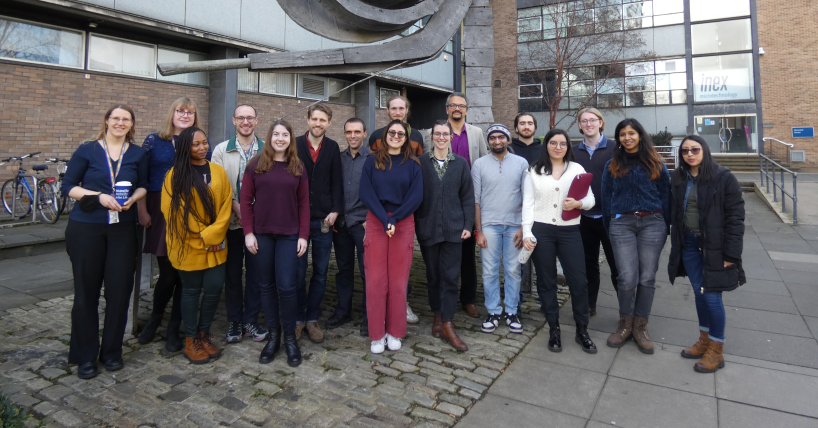
Group members
Academic staff and fellows
Postdoctoral research associates
Dr Nisha Grewal
Dr Paloma Guetzoyan
Dr Jan Henneco
Dr Vladislav Loktev
Dr Nicolás Moraga
Dr Laura Scott
Dr Keegan Thomson-Paressant
Postgraduate Students
Karthika Bhuvanendran
Pieterjan Van Daele
Logan Dennis
Danny Dixon
Melissa Ewing
Beth Gould
Daniel Hill
Ankur Kalita
Rintaro Kanaki
Devang Liya
Charlie MacMahon
Carolyn Mill
Federica Nardini
Rion Glenn Nazareth
Charlie Perkins
Rose Shepherd
Aditya Verma
Niek Wielders
Carola Zanoletti