Geophysical and Astrophysical Fluid Dynamics
Focusing on the fluid dynamics and magnetohydrodynamics in geophysical and astrophysical systems.
Research group focus
The Geophysical and Astrophysical Fluid Dynamics group studies the fundamental behaviour of fluids and magnetic fields in natural systems, spanning environments from Earth to the largest structures in the Universe. The group combines analytical studies, high-performance numerical simulations, and laboratory experiments to understand complex, multi-scale fluid processes.
Areas of focus include:
- fluid dynamics of Earth’s oceans and atmosphere, including waves, instabilities, and submesoscale processes
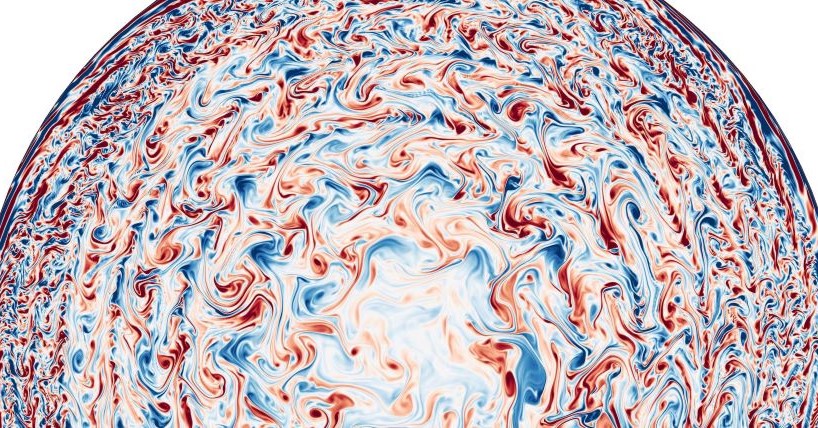
- planetary interiors and atmospheres, including rotating convection, large-scale vortices and double-diffusive convection
- dynamo theory and magnetic field generation in planets, stars, and galaxies
- stellar and solar interior dynamics, including magnetohydrodynamic instabilities and internal gravity waves
- astrophysical flows such as accretion discs, galactic outflows, and the interstellar medium
- turbulence, waves, and transport processes in geophysical and astrophysical systems
Research impact
The group’s research advances fundamental understanding of fluid and magnetohydrodynamic processes in Earth science, planetary science, and astrophysics. By addressing problems such as magnetic field generation, turbulence, and wave dynamics, the group contributes to explaining observations ranging from ocean circulation to galaxy evolution.
The group operates at the interface of applied mathematics and physics. Our work has broad scientific and interdisciplinary impact, including:
- improving understanding of geophysical dynamics, with relevance to climate and environmental processes
- advancing knowledge of planetary and stellar evolution through dynamo theory and interior modelling
- contributing to astrophysics through studies of galaxies, black hole growth, and interstellar turbulence