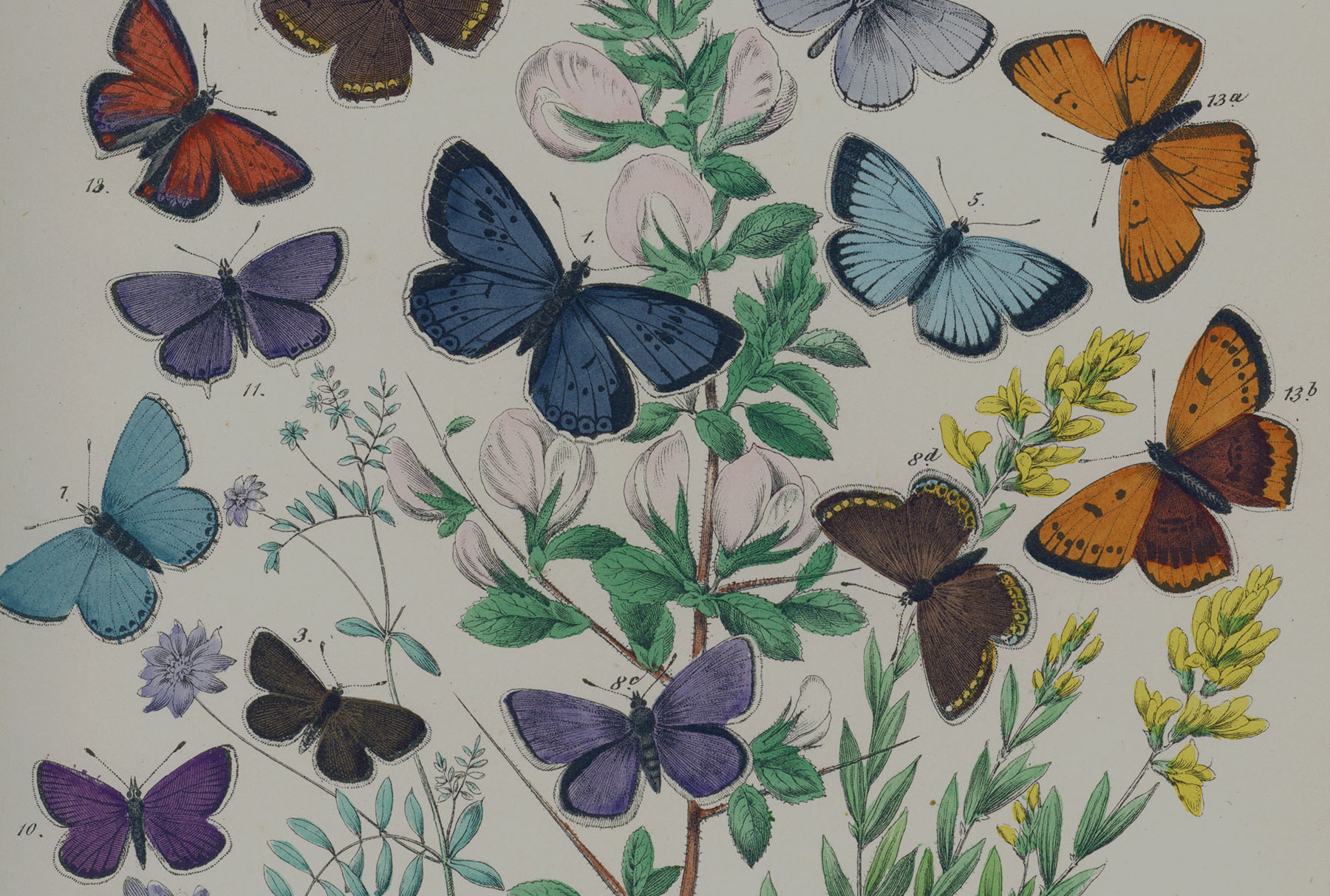
The Short-horned Grasshopper
Entomology is the study of insects. Among the best examples of British entomological illustration from the late-eighteenth and early-nineteenth centuries are the 770 hand-coloured copper plates of insects in botanical settings, such as this short-horned grasshopper, in British entomology: being illustrations and descriptions of the genera of insects found in Great Britain and Ireland by John Curtis (London: Lovell Reeve & Co., 1862).
The Short-horned Grasshopper
Entomology developed quickly in the nineteenth and twentieth centuries and John Curtis was described, in his obituary in the Proceedings of the Linnaean Society, as “one of the most accomplished delineators of insects, and one of the closest observers of the phenomena of insect life”. British entomology was originally issued in monthly parts, over a period of 16 years (1824-1839). Curtis hand-coloured the proofs and supervised people that coloured the plates. In 1862 the publisher, Lovell Reeve, released a partial reprint that contained hand-coloured lithographic copies of the plates.
Reference: Ent. Coll. 595.70942 CUR, British Entomology: Being illustrations and descriptions of the genera of insects found in Great Britain and Ireland (1862), Entomology Collection, Newcastle University Special Collections, GB 186.
Potential research ideas
This image depicting a short-horned grasshopper could prompt research into the relationship between science and art. For example, you could investigate how developments in illustrative techniques contributed to the body of entomological knowledge and understanding. You might think about the impact that print and illustration had on the dissemination of scientific information. Or, conversely, you might explore whether scientific advancement, such as the field of microscopy, influenced book illustration. In the Nineteenth Century, insects became fashionable in the creative arts: from fashion to art to literature and especially the anthropomorphic characters in children’s books. You could, then, explore the many ways in which biomimicry infused Victorian culture. How did this fascination with insects manifest itself? Was it playful, focused on ideas of beauty, or did it reflect fears and distorted views of science and modernity? Thinking about children’s engagement with the natural world, you might want to find out how popular authors presented insects in their work. In the Nineteenth Century, children joined natural history or nature societies. What messages were communicated to children about the natural world?
Selected background reading
- Smith, J., 2006. Charles Darwin and Victorian visual culture. Cambridge: Cambridge UP. – Book illustration, natural history illustration and the influence of Charles Darwin in the Nineteenth Century.
- Breidbach, O., 2006. Visions of nature: the art and science of Ernst Haeckel. Munich; London: Prestel. – Aesthetics, natural history illustration and the influence of Ernst Haeckel.
- Buchanan, H., c.1979. Nature into art: a treasury of great natural history books. New York: Mayflower Books. – The history of zoological and botanical illustration.
- Weiss, H.B. 1939. “An Early Entomological Book for Children.” Journal of the New York Entomological Society, vol. 47, no. 4. [Online] Available at: jstor.org/stable/25004827. (Accessed 11/07/2020). – Entomology and children’s literature.
- Dixon, D., 2001. “Children's Magazines and Science in the Nineteenth Century.” Victorian Periodicals Review, vol. 34, no. 3. [Online] Available at: jstor.org/stable/20083807. (Accessed: 11/07/2020). – Children’s magazines as vehicles for popularising science and science eduction.
What can I find here in Special Collections?
- Rennie, J. & J.O. Westwood, 1829-1835. The natural history of insects. London: J. Murray. 19th Coll. 082 FAM, 19th Century Collection, Newcastle University Special Collections, GB 186. – Two volumes on insects from the Family Library series.
- Bewick, T., 1815? A natural history of reptiles, serpents, and insects: thirty-five engravings on wood. Alnwick: W. Davison. Bradshaw-Bewick 761 BEW, Bradshaw-Bewick Collection, Newcastle University Special Collections, GB 186. – A children’s book by celebrated wood engraver and naturalist, Thomas Bewick.
- Bewick, T., 1819. A description of above three hundred animals, or, An interesting natural history of quadrupeds, birds, fishes, serpents, and insects: carefully abridged from Buffon, Swammerdam, Brookes, Goldsmith, &c. With upwards of three hundred elegant engravings on wood. Alnwick: W. Davison. Burman-Alnwick 190, Burman-Alnwick Collection, Newcastle University Special Collections, GB 186. – An illustrated natural history book.
- Bruyssel, E. van, 1870. The population of an old pear tree, or, Stories of insect life. London: Macmillan. Alderson Collection BRU POP, Alderson (Brian) Collection, Newcastle University Special Collections, GB 186. – Juvenile fiction about insects.
- Blackburn, H. & R. Caldecott, 1890. Randolph Caldecott’s sketches. London: Sampson Low, Marston, Searle & Rivington Ltd. 19th Coll. 741.9241 CAL, 19th Century Collection, Newcastle University Special Collections, GB 186. – On the work of Randolph Caldecott.
- Cheesman, E., et al., 1924. Everyday doings of insects. London: George G. Harrap. Alderson Collection CHE EVE, Alderson (Brian) Collection, Newcastle University Special Collections, GB 186. – A children’s book on insect behaviours.
- Selous, E. & J.A. Shepherd, 1910. Jack’s insects. London: Methuen & Co. Butler 823.8 SEL, Butler (Joan) Collection, Newcastle University Special Collections, GB 186. – Juvenile fiction.
- Thomson, J.A., [1932] The ways of insects. London: George Newnes. Butler 595.7 THO, Butler (Joan) Collection, Newcastle University Special Collections, GB 186. – A children’s book.
What can I find elsewhere?
- The Natural History Society of Northumbria is based in Newcastle. Its library holds over 12,000 natural history books and journals and its archives comprise more than 16,000 letters, works of art, diaries and notebooks.The collection items you will find there include:
- TWCMS: B5996: Plate with white ground and green blue transfer decoration comprising floral scene with insects and birds (1881-1896).
- NEWHM: 1998.H8006.2: Notebook – manuscript nature notes on birds, insects . . . in the North East of England . . . (1928-1938).
- The Victoria and Albert Museum has collected illustration since it was founded. It’s collection includes book illustrations, botanical illustration, fashion plates and a range of sketch books, drawings and printing blocks. Curated online exhibitions showcase their holdings according to theme. For example, Beatrix Potter: drawn from nature focuses on the children’s author’s entomological sketches.