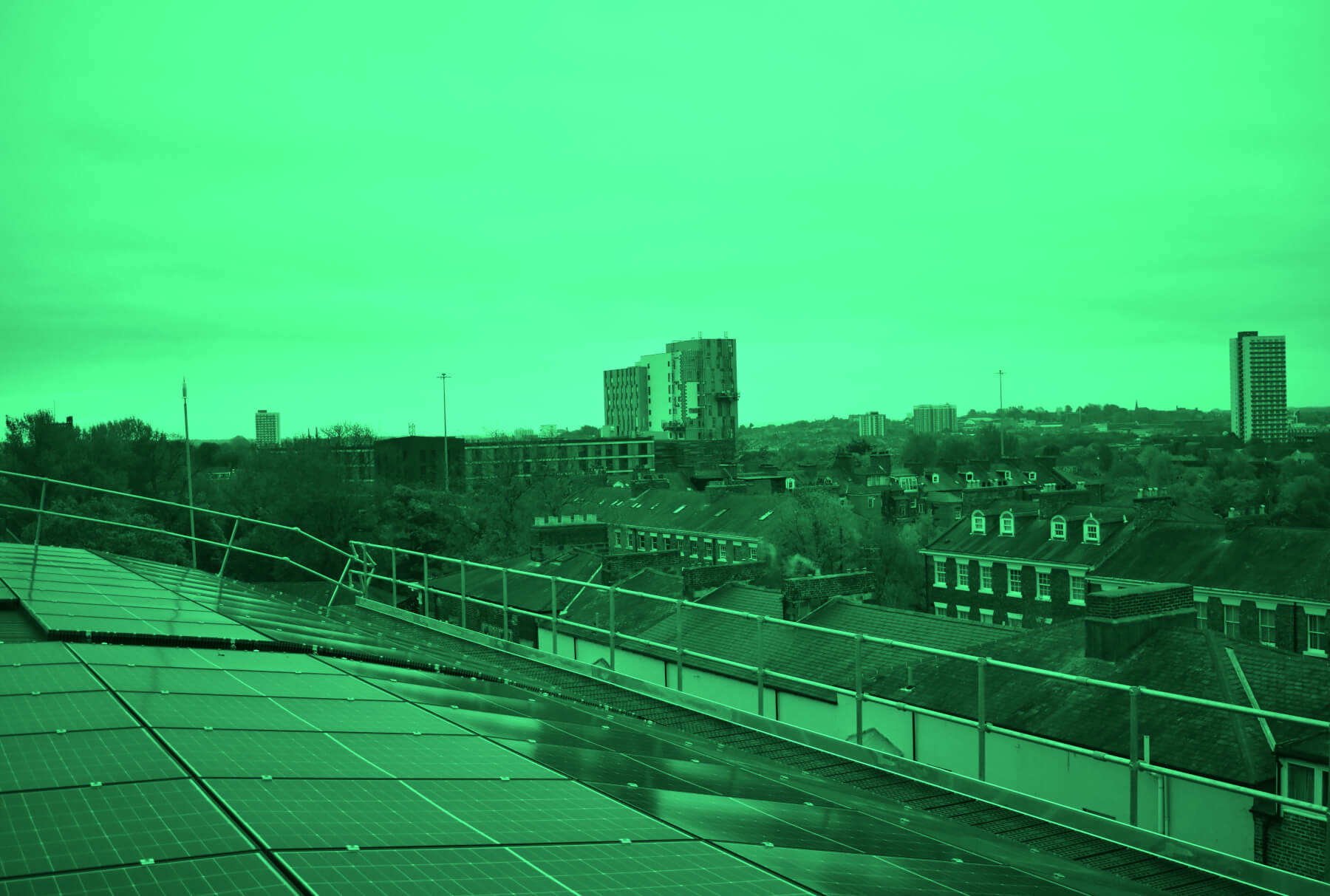
Sustainable Solar Energy
Find out about the energy generated by our solar panels powering our libraries, and our other green initiatives.
Newcastle University has invested in expanding solar PV (photovoltaic) arrays across buildings on campus, with the current installed capacity exceeding 2.5MW.
The Philip Robinson Library and Research Reserve in Team Valley have solar PV arrays with a total capacity of 379KW, which has increased the renewable share of electricity used in both buildings.
Learn more about Newcastle University's investment in solar power
Newcastle University has invested in expanding solar PV arrays across buildings on campus, with the current installed capacity exceeding 2.5MW.
Solar PV arrays provide a fossil-fuel free source of electricity which is helping the University towards reaching our Net Zero by 2030 target.
They work by converting photons from sunlight into electricity. As the sun provides an infinite source of energy this production is classed as renewable. It is also a more environmentally friendly way of generating electricity as no harmful greenhouse gases are released through the process unlike other forms which use fossil fuels.
Further information on how the University is working towards these targets can be found in our Climate Action Plan and on our Sustainable Campus webpage.
Understanding these metrics
Further explanation of the above lifetime metrics, which illustrates the scale of the electricity produced so far:
- CO2-equivalent saving - the current lifetime saving of CO2-equivalent in tonnes from using solar PV generated electricity compared to using this from grid electricity.
- Tree planting equivalent - the number of new trees would need to be planted to create the equivalent CO2e saving. This figure is not an exact science as there are many factors to determine the saving of CO2 provided by trees, but it gives some perspective as to the beneficial impact that the Solar PV arrays have had through their lifetime.
- Light bulbs - the number of light bulbs that could be powered in a single day, based on the electricity produced so far by the solar PV arrays.