-(1).jpg)
Newcastle University hosts international conference on second language interaction research
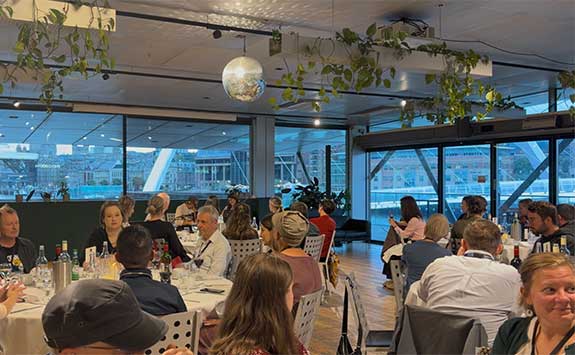
Researchers from around the world gathered at Newcastle University last month, for an international conference exploring how languages are learned, taught and assessed through interaction.
28 September 2026
Hosted by colleagues in the Applied Linguistics and Communication Subject Area of the School of Education, Communication and Language Sciences (ECLS), and chaired by Dr Chris Leyland, the event took place from 24 to 26 August 2026.
The conference brought together researchers at all career stages to share new research findings on second-language interaction across educational, assessment, professional and digital settings.
This year's conference was the largest to date, featuring contributions from 148 researchers across 81 institutions and 23 countries.
The conference welcomed 130 attendees and was the first time ICOP-L2 had been hosted in the UK, following previous editions in Switzerland, Sweden, Spain and Denmark.
A global research perspective on second language interaction
The 2026 conference was the fifth Interactional Competences and Practices in a Second Language (ICOP-L2) Conference.
Since the first conference in 2017, ICOP-L2 has developed into an important international forum for researchers studying second-language interaction.
The conference series reflects growing interest in how people communicate, learn and establish mutual understanding across languages.
This research has practical relevance for language teaching and assessment, multilingual workplaces, digital communication and other areas of public and professional life.
As increasing numbers of people live, work and study across languages and cultures, understanding second-language interaction is more important than ever.
Research in this field examines how people develop the ability to participate effectively in interaction and how communication is shaped by social, educational, professional and technological contexts.
Its findings can inform the design of language-learning activities, speaking assessments and more inclusive communication practices.
...the conference reinforced the importance of understanding the human aspects of interaction and how people build meaning, relationships and understanding through language.
Showcasing Newcastle’s expertise in language and communication research
Hosting ICOP-L2 2026 showcased Newcastle University’s longstanding contribution to research on language and social interaction.
Over more than two decades, colleagues in Applied Linguistics and Communication have established an international reputation for research across educational, professional and digital settings.
Emeritus Professor Paul Seedhouse delivered the opening keynote on the relationship between language and the “interaction engine”.
Read more about the "interaction engine"
Current Newcastle University colleagues Chris Leyland, Katherina Walper, Michael Stephenson, Adam Brandt, Spencer Hazel and Müge Satar also contributed presentations on language teaching and assessment, classroom interaction, technology-mediated learning and conversational AI.
The conference highlighted both the future and the wider reach of Newcastle’s interaction research community. ECLS doctoral researchers Zemo Hongze Yang and Lewis Hayes presented their work, alongside Newcastle alumni Olcay Sert of Mälardalen University, Aki Siegel of Stockholm University and Kaisa Pietikäinen of the Norwegian School of Economics.
Further keynote presentations were delivered by Silvia Kunitz of Linköping University, on task-based language teaching and interaction, and Daniel Lam of the University of Glasgow, on conversation analysis and language assessment.
Chris Leyland said:
‘It was fantastic to welcome researchers from around the world to Newcastle and showcase the strength of our research in this area. The conference highlighted the breadth of innovative work across the field and the increasingly collaborative nature of the research community, with more than one-third of presentations jointly authored and many resulting from international collaborations.
‘Many of the discussions highlighted how rapidly the field is evolving, particularly in response to developments in artificial intelligence and digital communication. At the same time, the conference reinforced the importance of understanding the human aspects of interaction and how people build meaning, relationships and understanding through language.’