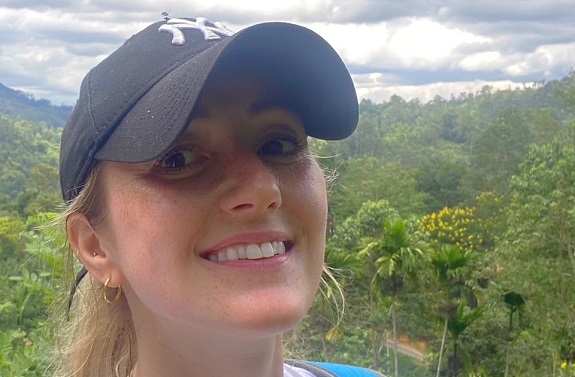
Eve Englefield
Conservation Graduate
Eve's career journey
Straight after Newcastle, I completed an internship at the Institute of Zoology, at ZSL, before completing my MSc in Conservation Science at Imperial College London, followed by a period of fieldwork (lemur behaviour research) in Madagascar. I then joined IUCN for a couple of years, with a focus at the European policy level, developing European Red Lists, supporting the Green List of Protected and Conserved Areas, and EU-level work around Invasive Alien Species, amongst other projects.
I then joined the Joint Nature Conservation Committee, where I worked with local governments and NGOs of British Overseas Territories to implement sustainable development and other conservation projects, bringing together my experience of local implementation.
I’ve had the opportunity and privilege to travel to some incredible places and to work with and learn from some of the best conservation professionals, both within the UK and internationally.
A solid scientific foundation
My time at Newcastle University provided a solid scientific foundation. Although my focus has since shifted more toward the social sciences and project implementation, having a broad knowledge of various natural science disciplines has enabled me to adapt to diverse roles and projects throughout my career.
Newcastle University was where I decided to pursue a career in conservation, and one of the key factors in me achieving that, was the support from my supervisor during, and after, my degree.
Newcastle, both as a city and a university, also simultaneously taught me how to work hard and play hard, which eventually led into an understanding of the importance of a work-life balance – something I have tried to maintain throughout my career. Additionally, I gained lifelong friendships – I still regularly see some of my course mates, and while only a couple have gone into conservation, it has also left me with a diverse professional network.
Having a lecturer (Phil McGowan) with direct experience in conservation was my first meaningful exposure to the field as a potential career path, and it was instrumental in shaping my decision to pursue it professionally
A network of conservation professionals
The opportunity to focus my dissertation on conservation policy provided me with a deeper understanding of the real-world challenges facing the sector. Through Phil's connections with IUCN, I was also able to engage directly with conservation professionals, gaining valuable insights. These experiences proved incredibly useful as a young graduate entering the field, as I was able to speak confidently about key issues in early career interviews.
With Phil's support, I was introduced to a network of conservation professionals, some of which became colleagues as my career developed. I remember early on realising how supportive and kind the conservation ‘bubble’ was, giving me both the confidence and motivation to explore my own career journey.
I’m confident that if it had not been for my time at Newcastle (and more specifically, Phil’s experience and support), I wouldn’t have explored as much of an interdisciplinary approach to conservation, and I definitely wouldn’t be where I am today!