
Creating Safe Spaces
NEW: A vision for education and skills at Newcastle University: Education for Life 2030+
Psychologically Safe Learning Environments
Our Education for Life Strategy aims to provide an education that engages, challenges and supports all students. To achieve this, we must create a psychologically safe environment supported by intentional strategies to foster open dialogue, encourage risk-taking, and support student growth.
"Psychological safety makes it more likely that students will engage in classroom activities and debates - this supports learning and helps develop a sense of community and belonging.”
Advance HE, Education for Mental Health Toolkit - Psychologically safe learning environment
Why is it Important?
Psychological safety underpins active learning
Active learning, as envisaged in our LEC, is grounded in social constructivism. It gives students agency and encourages participation through their collaboration, critical thinking, application and reflection. Through active learning, students are invited to make their thinking visible to peers and tutors, for instance through questioning, discussion and peer feedback. For these activities to be meaningful, students need to feel that the learning environment is psychologically safe. When students feel respected, included and supported, they are more likely to engage with one another, share ideas and learn from different perspectives.
Because active learning often asks students to speak openly, contribute in front of others and to take risks, a sense of belonging is especially important. Psychologically safe learning spaces can help to reduce anxiety and make engagement feel more possible, particularly for students who may be less confident, or who are still finding their place within the learning community.
Therefore, psychological safety does not mean lowering expectations or avoiding challenge. Rather, it creates the conditions for honesty, openness and thoughtful challenge to flourish. In doing so, it supports a learning environment that is both more collaborative and more intellectually demanding.
Psychologically safe learning environments are created through thoughtful course design, inclusive teaching approaches, and supportive peer collaboration in the classroom.
Psychological safety and performance standards
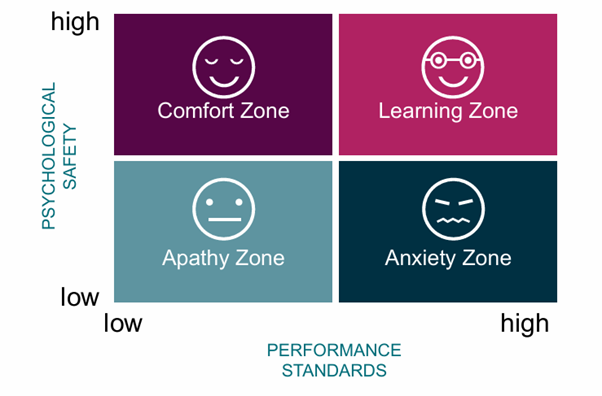
Our aim is to create learning conditions that encourage students to move beyond their comfort zone and into a space where learning can happen without tipping into overwhelm or anxiety, as illustrated in the diagram below. The diagram originates from Amy Edmonson’s (2018, 2019) work on psychological safety in an organisational context but can be transferred to an educational context.
The four quadrants represent all possible combinations of psychological safety and performance standards, each ranging from low to high. Low safety and low standards create the Apathy Zone, while low safety paired with high standards results in the Anxiety Zone. High safety with low standards leads to the Comfort Zone, and high safety combined with high standards creates the Learning Zone.
Design a psychologically safe and inclusive environment
Thoughtful design of safe learning environments ranges from curriculum-level design to individual lesson plans.
- Carefully plan the integration of psychological safety from the very beginning by using Universal Design for Learning (UDL) to cater for learner diversity. Embedding accessibility and flexibility during curriculum and module design reduces the need for continuous adjustments later on.
- Anticipate the varied needs of learners when planning lectures or lessons and selecting resources. This creates a learning environment where everyone feels safe and supported. For instance, providing course materials well in advance benefits all students.
- Remember to address the social and cultural dynamics of your classroom. Students from underrepresented groups might feel less confident to speak up . These include students from minoritised, students with mental health conditions, LGBTQ+ students, care-experienced and mature students, and international students. Make explicit that diverse perspectives are valued and encouraged.
Create and maintain a welcoming and safe learning environment
Evidence shows that when students feel welcomed, valued, and that they belong, they are more likely to thrive in their studies. There are some simple ways to help create this sense of welcome from the outset:
- Introduce yourself warmly.
- Explain clearly when and how students can contact you.
- In smaller group settings, invite students to share how they would like to be addressed or known.
- Co-create ground rules or a learning contract from day 1.
- Consider carefully how you form teams or groups.
These small acts can help students feel recognised, respected, and more comfortable engaging in the learning environment.
Use the Classroom Contract Template below to co-create a classroom contract helping students to understand what is expected of them and feel more confident about how to engage in a psychologically safe and inclusive environment. The template is based on the Psychological Safety Action Pack - Psych Safety
Plan lessons with clear, intentional structure
Once a positive welcome is established, a clear lesson structure continues to shape students’ sense of psychological safety. Well‑planned and clearly signposted activities help learners feel safe so that they will take risks, contribute and collaborate.
- Briefly explain the concept of psychological safety and its significance, drawing on short examples.
- Use icebreakers, where appropriate, to explore students’ experiences and strengths and to foster a sense of belonging and group identity.
- Build in regular opportunities for quick check-ins and polling, e.g. on Vevox, and other low-pressure ways to contribute.
For ideas to foster social engagement and collaborative learning, see our Learning Communities webpage, which includes a toolkit with icebreakers and other activities.
Encourage experimentation and risk-taking
Where possible, reduce reliance on a small number of high-stake assignments and incorporate low-stake formative tasks or assignments that value creative thinking, curiosity and iterative learning rather than only correct answers.
Problem-based learning, teamwork and peer assessment can help students to feel more able to take risks without fear of failure or poor grades.
Normalise failure as a learning tool
Failure is often a natural part of pursuing goals and trying something new. Developing resilience by learning from mistakes and seeing them as opportunities helps learners to grow.
- Model a growth mindset by sharing your own academic or professional setbacks and explaining how you overcame them.
- Encourage reflection on mistakes and frame failure as a step toward mastery.
- Offer constructive feedback/feedforward that helps students understand how to improve, rather than focussing primarily on error or penalty.
Promote open dialogue and questions
Encouraging questions and structured discussion helps foster an open learning environment.
- Set clear expectations that all questions are welcome at every opportunity, reinforcing this by actively listening and responding without judgment.
- Use structured discussion formats like polling, Think-Pair-Share, or discussion boards that encourage participation, especially for students who may hesitate to speak in class (see Teaching Approaches below for details) .
Encourage intellectual challenge and debate
Create a culture where challenging ideas is seen as a normal and valuable part of learning.
Establish discussion norms:
- Listening respectfully.
- Supporting claims with evidence.
- Responding constructively.
This can help students feel comfortable engaging in debates without fear of ridicule or dismissal.
Think about the tone of your feedback
Feedback should support students’ development and help guide their next steps in learning. It is not only what we say that matters, but also how we say it.
- Use warm, constructive, and encouraging language, which can help students feel respected, motivated, and better able to act on feedback.
- Where possible, begin by highlighting what the student has done well and what they should continue doing, before offering clear guidance on how they can develop further.
This helps feedback feel supportive, forward-looking, and focused on growth.
Think-Pair-Share
Think-Pair-Share is a well-tested active learning approach used at Newcastle University that supports reflection and collaboration.
It consists of three steps.
Think – Students reflect individually on a question, task or problem presented to them (5 minutes).
Pair – Students discuss their ideas with a partner (5 minutes)
Share – Pairs share their answers with the rest of the group or the whole class (10 minutes)
This approach encourages discussion and debate by creating a safe space where students can articulate their thinking, share ideas and ask questions, with everyone actively involved.
Polling
Newcastle University’s supported polling system Vevox allows students to participate in polls, quizzes and surveys before or during class without having to speak up.
You can find out more on our page Vevox | Learning and Teaching @ Newcastle | Newcastle University
Discussions
Structured discussions encourage participation and open dialogue, enabling students to share and challenge ideas in a safe way once discussion norms have been established.
Learn more about how to use Canvas Discussion Boards in your teaching. Where appropriate, anonymous settings can help encourage students to ask questions.
Playful learning
Playful learning creates a psychologically safe environment that supports learning from failure and risk-taking and fosters creativity and innovation.
Well‑established playful learning tools and techniques include role‑plays, simulations, problem‑based learning activities, fun activities, and the use of Lego in the classroom.
Case studies about games that enhance communication and teamwork skills
References and Further Reading
Advance HE (2025). Education for Mental Health Toolkit - Psychologically safe learning environment.
https://www.advance-he.ac.uk/teaching-and-learning/curricula-development/education-mental-health-toolkit/social-belonging/psychologically-safe-learning-environment
Charteris, J., Anderson, J., & Page, A. (2024). Psychological safety in innovative learning environments: planning for inclusive spaces. International Journal of Inclusive Education, 28(5), 688-704. https://doi.org/10.1080/13603116.2021.1974108
Donkin, S., Kirman, J., Payne, R., Storr, S., & Pearse, S. (2025). Everyone can benefit from a more trauma-informed approach to higher education.
https://www.advance-he.ac.uk/news-and-views/everyone-can-benefit-more-trauma-informed-approach-higher-education
Edmondson, A. C. (2019). Psychological safety [Conference presentation]. Lean Enterprise Institute. https://www.lean.org/wp-content/uploads/2022/01/pl_Psychological_Safety.pdf
Edmondson, A. C. (2018). The fearless organization: Creating psychological safety in the workplace for learning, innovation, and growth. John Wiley & Sons. Available from the Newcastle University Library
Elliott, G., & Pinhal‐Enfield, G. (2026). Evaluating major curriculum changes: Ensuring a psychologically safe learning environment is achieved for graduate students. Anatomical Sciences Education, 19(1), 93-99. https://doi.org/10.1002/ase.70144
Huerta, M. V., Sajadi, S., Schibelius, L., Ryan, O. J., & Fisher, M. (2024). An exploration of psychological safety and conflict in first‐year engineering student teams. Journal of Engineering Education, 113(3), 635-666. https://doi.org/10.1002/jee.20608
Johnson, C. E., Keating, J. L., & Molloy, E. K. (2020). Psychological safety in feedback: What does it look like and how can educators work with learners to foster it? Medical Education, 54(6), 559-570. https://doi.org/10.1111/medu.14154
Lateef, F. (2020). Maximizing learning and creativity: Understanding psychological safety in simulation-based learning. Journal of emergencies, trauma, and shock, 13(1), 5-14. https://doi.org/10.4103/JETS.JETS_96_19
Robinson, H., & Held, F. (2025). What’s the crucial element for interdisciplinary teamwork? Psychological safety.
https://www.timeshighereducation.com/campus/whats-crucial-element-interdisciplinary-teamwork-psychological-safety
Soares, A. E., & Lopes, M. P. (2020). Are your students safe to learn? The role of lecturer’s authentic leadership in the creation of psychologically safe environments and their impact on academic performance. Active Learning in Higher Education, 21(1), 65-78. https://doi.org/10.1177/1469787417742023
Whitton, Nicola (2022). Play and learning in adulthood: Reimagining pedagogy and the politics of education, Springer International. Available from the Newcastle University Library