
Programme Focussed Assessment
NEW: A vision for education and skills at Newcastle University: Education for Life 2030+
Introduction
Most of our taught programmes at Newcastle University are modular. While this brings flexibility and efficiency, it can also encourage compartmentalised learning unless assessment is designed and communicated at programme level.
By taking a holistic, programme focussed approach we can design assessment and feedback so that students to experience assessment as part of an intentional journey. This approach prioritises learning, reduces unnecessary assessment burden, and strengthens inclusion.
1. Assessments at module level contribute to programme level learning outcomes.
At module level:
- At approval and review, ensure that module learning outcomes (MLOs) are explicitly mapped to programme learning outcomes (PLOs). Ensure that assessment briefs make these links visible to students and colleagues.
- Which MLOs are assessed and how do tasks evidence them?
- Do briefs, criteria and workload guidance explain the task’s purpose and relevance?
At programme level:
- Do the module assessments collectively safeguard standards and evidence PLOs?
- Where are gaps or over-assessment, and what can be streamlined or combined
2. The links between assessment tasks across the stage / programme are clear to students
Before coming to university, students will have been accustomed to studying separate subjects that are assessed independently. They may not necessarily see that feedback from one module is applicable to another later in the programme. Students should be able to see how feedback and performance in one module supports success in the next.
At module level:
- Point students back to prior assignments where feedback will be relevant
- Explain how current skills will be built upon later in the programme
At programme level:
- Adopt a standard assessment brief across modules.
See our guidance on assessment briefs. - Use shared language/structure in criteria and rubrics.
See our guidance Writing Assessment Criteria and Rubrics. - Create structured opportunities for students to work with criteria. (Periodically co create or review rubric language with students.)
3. The assessment mix supports student skill development.
Use a diverse range of assessment types across the programme. Prioritise authentic tasks that connect to research, industry, practice, or society.
At programme level:
- Is there variety in the assessment methods?
- Do tasks enable students to practise and evidence knowledge application, collaboration, communication, professional and career skills?
- Can any modules adjust assessment type to improve the mix?
- Plan alternative assessments where assessment types present known barriers for groups of students.
See our Inclusive Assessment Resource.
4. Assessment are planned so that students have opportunities to reflect and act on feedback
Plan assessment timing so students can use feedback to improve subsequent work.
At programme level
- Sequence tasks across modules so feedback can be acted upon
- Plan feedback rich formative elements across each stage. This could be formative assessment, in-class practice, or low stakes assessment.
- Make it easy for students to identify how feedback can be used to improve their future work. See What makes good feedback.
At module level:
- Ensure that formative tasks or assessment give students sufficient time to act on feedback.
- In the first week of your module inform students about the types of feedback they will receive and when to expect the feedback.
5. Assessment workload for students is manageable across the programme/stage
If assessments are bunched in a short period of time, this can affect real learning opportunities and creates unnecessary stress for students.
Evaluate Workloads
Produce a week by week assessment map per semester to avoid deadline bunching for compulsory modules.
- Are deadlines balanced? Can assessment deadlines be adjusted?
- What workload is attached to each assessment? Are these fair in terms of the credit value? Are work expectations clear to students?
- Is there sufficient formative assessment/practice?
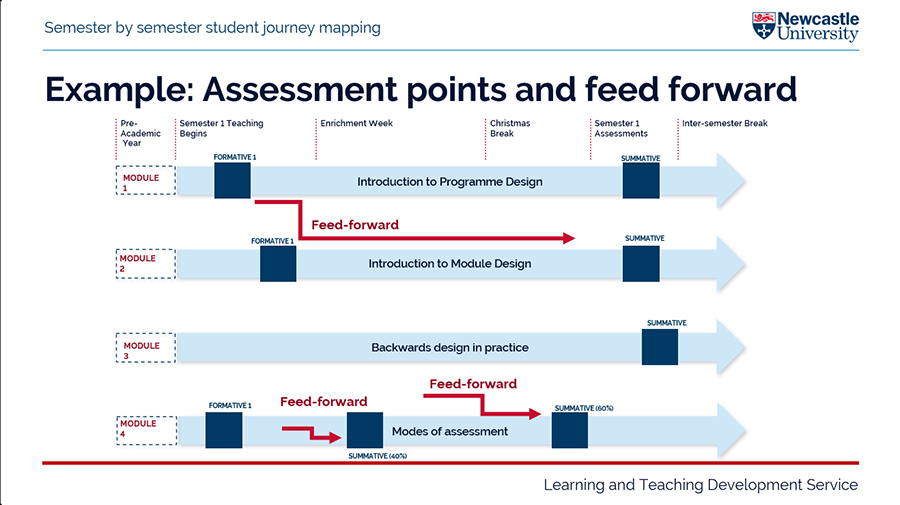
Use the Semester by Semester Student Journey Mapping resource to help you visualise student deadlines.
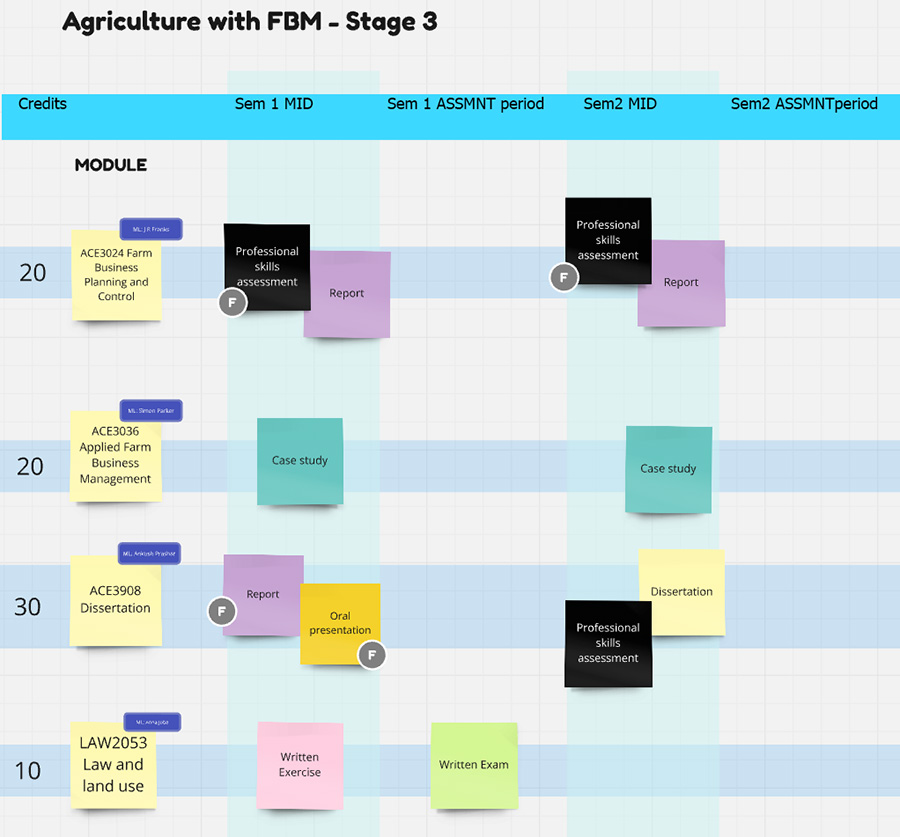
You can also use physical or virtual post-its notes to mark programme-level assessment, stage by stage, on a timeline (example Miro from a concluded AESSC project).
6. The programme team negotiate shared feedback practices
Some variation in feedback mechanisms across a programme will be normal, e.g., some colleagues may like to use audio feedback on some assessments. However, students will be supported to find and engage with feedback if there is some commonality in tools and approaches:
- Use common assessment tools – if some colleagues mark using Turnitin and others use SpeedGrader, students will need to use different interfaces to access feedback. Having a consistent approach will support students.
- Agree on a consistent method of structuring feedback – e.g., where rubrics are used, will students expect to see comments next to each rubric element, or should they focus on the overall assessment comments?
- Agree key phrases to include in your feedback eg “For future work”
Communicating a programme view of assessment
Use your maps and audits to create student friendly views of the programme assessment journey: list assessments for each stage with a short narrative; create an assessment/programme journey map; show where feedback/feedforward loops occur and how they support later tasks.
See our blog post on Visualising Programme Level Assessment for examples.
Assessment in our Leading Edge Curriculum
Our Leading Edge Curriculum (LEC) defines a number of important parameters for assessment design at programme level.
These include:
- The quantity of authentic assessment (connecting to students’ futures)
- The requirement to surface Education for Life Skills and attributes in your assessments
- The need to implement assessment in a way that protects the integrity of the award.
- Embedding inclusive assessment practice in assessment design and delivery.
- Including an individual component in summative group work.
The Curriculum Transformation Team will support programme teams working through the redesign process.