Physics MPhys Honours
2027 entry information
- Study mode and duration
- Full time: 4 years
- UCAS code
- F303
- UCAS institution name and code
- NEWC / N21
- Tuition fees (Year 1)
-
FT Home: £10,050
FT International: £32,600 Scholarships available - Typical entry requirements
-
A-Level: AAB
IB: 34 points
View alternative offers - Course delivery
- On Campus
- Work placement opportunity Study abroad option Professional accreditation and recognition
Course overview
Our Physics MPhys is designed for students who want to explore physics in depth and tackle research-level challenges. This integrated Master’s degree goes beyond the BSc, giving you the opportunity to study advanced topics and develop specialist expertise.
A key part of the course is a substantial extended research project under the guidance of our academic staff. This allows you to explore an area of physics you are passionate about in great detail.
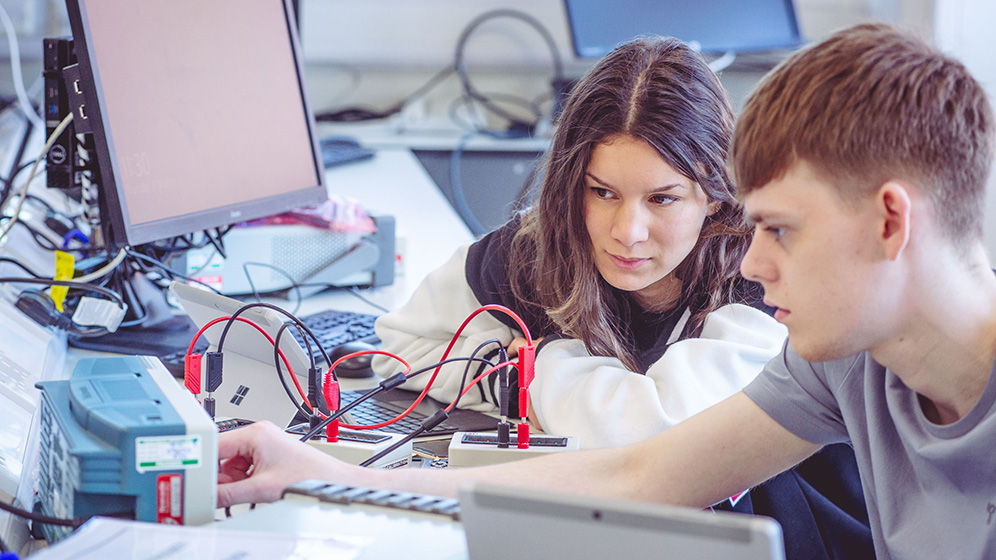
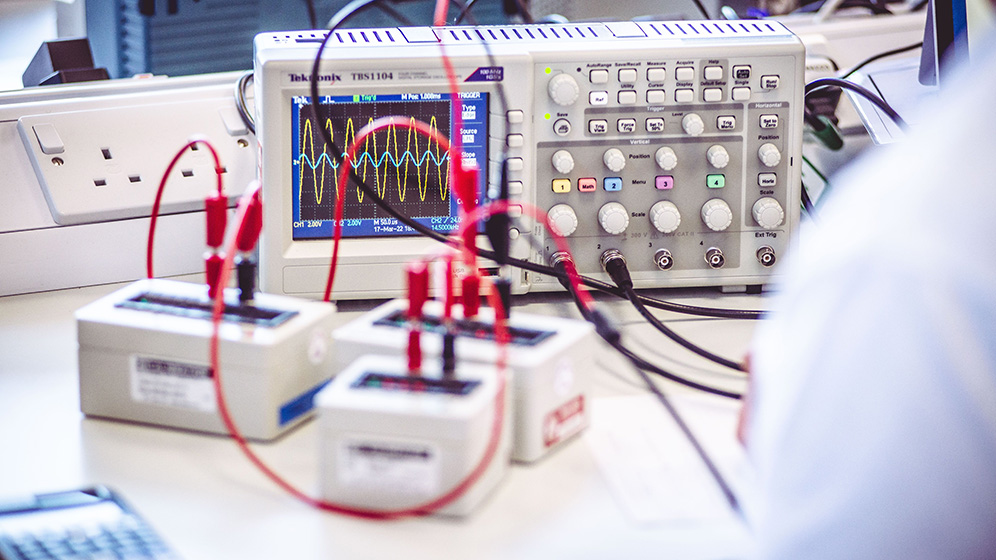
You’ll gain hands-on experience in our high-spec laboratories, enhanced by a £2.7 million investment. These include specialist spaces such as dark and cryogenics labs, alongside large, state-of-the-art teaching labs. You’ll apply advanced physics concepts and mathematics to investigate real-world problems, developing practical, analytical, and research skills.
You’ll learn in a supportive, people-focused environment:
- transition support helps you move confidently from school to university-level study, so you can settle in quickly and thrive
- high contact hours mean more time learning with others, guided by friendly, approachable staff committed to your progress
- research-led teaching from recognised experts in astrophysics, quantum matter, cosmology, and emerging technologies ensures you engage with cutting-edge ideas throughout your degree
By the end of the course, you’ll have a deep understanding of physics and the skills valued in academia, industry, and beyond. The degree is accredited by the Institute of Physics (IoP), meeting rigorous professional standards for physics education.
Flexible degree structure
Our flexible degree structure allows you to tailor your studies. All students follow the same curriculum in Stage 1, and begin to specialise in Stage 2. You can transfer between Physics disciplines until the end of Stage 1. You can also switch between the MPhys and BSc of your chosen discipline until the end of Stage 2:
MPhys or BSc?
Physics is offered at two levels:
- three-year Bachelor of Science (BSc)
- four-year Master of Physics (MPhys)
Quality and ranking
Professional accreditation and recognition
Professional accreditations are reviewed regularly by professional bodies to ensure they meet the latest industry practices and regulatory standards. This keeps your degree rigorous, relevant, and highly valued by employers, providing a clear pathway into your chosen career.
If you are studying an accredited degree and considering a career in Europe after graduation, it is important to stay informed about international standards. The best resource for current information is the UK Government's guidance on recognition of UK professional qualifications in EU member states.
This official resource provides essential details on:
- whether your profession is regulated in another country.
- the specific steps you need to take to practice abroad.
- which organisations you should contact to begin the process.
Our students


Daniel from United Kingdom
Theoretical Physics MPhys
Physics is the subject which lets you study everything to the smallest detail.


Fatima from Pakistan
Data Science BSc
Studying in such a diverse environment where I could meet people with different backgrounds and experiences was a big reason I chose Newcastle.
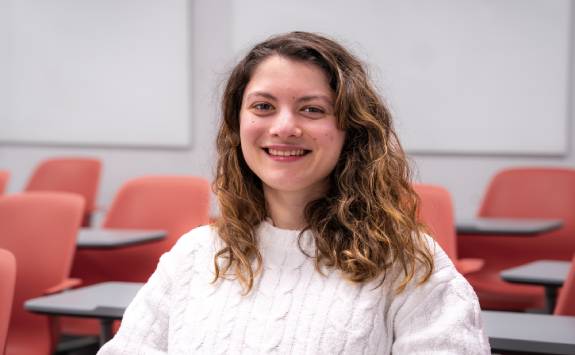

Ariana from Romania
Physics with Astrophysics BSc
My favourite part of the course is being able to interact with other disciplines that may spark my interest in other areas.

James from United Kingdom
Physics with Astrophysics MPhys
The course really stood out, and the modules really appealed to what I wanted to go into in my future career.

Lawrence from United Kingdom
Mathematics MMath
There’s a great balance between mathematical theory and computational work.
What you'll learn
Modules
The information below is intended to provide an example of what you will study.
Most degrees are divided into stages. Each stage lasts for one academic year, and you'll complete modules totalling 120 credits by the end of each stage.
Full details of the modules on offer will be published through the Programme Regulations and Specifications ahead of each academic year. This usually happens in May.
Our teaching is informed by research. Course content may change periodically to reflect developments in the discipline, the requirements of external bodies and partners, and student feedback.
During your first year, you’ll take introductory modules in physics and mathematical techniques, preparing you for in-depth, research-focused study in later years. You’ll explore physics first-hand in our high-spec labs, conducting experiments, testing ideas, and uncovering results for yourself.
Modules
| Compulsory Modules | Credits |
|---|---|
| Introductory Algebra | 10 |
| Introductory Calculus and Differential Equations | 20 |
| Multivariable Calculus | 10 |
| Dynamics | 10 |
| Introductory Astrophysics | 10 |
| Introductory Electromagnetism | 10 |
| Introductory Quantum Mechanics | 10 |
| Laboratory Physics 1 | 20 |
| States of Matter, Waves & AC Theory | 20 |
You'll continue learning about the core concepts of physics, including quantum mechanics and electromagnetism. You'll also be introduced to new physical theories and behaviours that build on your taught modules, with a strong focus on experimental design, troubleshooting, and analysing results which are essential skills for modern scientific research.
Modules
During this year, you’ll study more advanced modules and work on a team project.
You'll choose multiple optional modules.
Modules
| Optional Modules | Credits |
|---|---|
| Fluid Dynamics I | 10 |
| Mathematical Biology | 10 |
| Individual Project | 20 |
| Cosmology | 10 |
| High Energy Astrophysics and Black Holes | 10 |
In your final year, you'll gain a deeper understanding of physics. These modules have a large research focus. You’ll also work on an extended research project with one of our research staff.
Modules
| Compulsory Modules | Credits |
|---|---|
| General Relativity | 20 |
| Quantum Fluids | 20 |
| Extended Project - MPhys Physics | 60 |
| Quantum Information and Quantum Modelling of Materials | 20 |
We base these figures and graphs on the most up-to-date information available to us. They are based on the modules chosen by our students in 2025-26.
Teaching time is made up of:
- scheduled learning and teaching activities. These are timetabled activities with a member of staff present.
- structured guided learning. These are activities developed by staff to support engagement with module learning. Students or groups of students undertake these activities without direct staff participation or supervision
How you'll learn
Teaching methods
You’ll learn through a mix of interactive teaching and guided practice, designed to help you build confidence and think independently. Methods include:
- lectures and seminars – learn key concepts and discuss their real-world applications
- small group tutorials – get personalised support and deepen your understanding problem classes – practise solving challenging physics and mathematical problems
- laboratory sessions – gain hands-on experience with experiments and equipment
- practical computing sessions – apply computational methods to model, analyse, and solve problems supervisor meetings – receive one-to-one guidance on your extended research project
In Stage 1, you’ll work on experiments and projects in our labs. These practical sessions will be about 45 hours in total.
Assessment methods
You'll be assessed through a combination of:
-

Assessments
-
Examinations – practical or online
-

Projects
-

Reports
Skills and experience
Practical experience
This degree will give you practical skills that can be applied across a wide range of roles and organisations. You'll also develop highly valued attributes such as:
- problem-solving
- time management
- resilience
- critical thinking and modelling
Using our high-spec facilities, and working alongside our expert staff, you'll:
- gain experimental experience in our state-of-the-art laboratories
- work on lab and project-based modules, based on real-world challenges
- develop analytical and computational skills, using industry-relevant software
- enhance your written and oral communication skills
- learn from experts in the field at a leading Russell Group university
- build hands-on experience of individual research
In Year 3, you’ll work on a group project that explores a physics-based problem, using your programming, research, and analytical skills to find solutions.
Business skills
Physics graduates are highly valued for their transferable skills. You'll graduate with strong abilities, including:
- problem-solving
- a logical, analytical mindset
- big data analysis
- communication
- teamwork
You'll have the opportunity to apply for a year-long industry placement or project/internship alongside your degree. It's a great chance to apply your skills in a professional setting and gaining valuable insight into the sector. Students studying Physics have completed a placement year at companies such as:
- GE Ventura Wildlife
- Department of Workplace and Pensions
- Perspective Financial Group
Research skills
In your final year, the extended research project is one of the defining features of the MPhys. You’ll:
- work closely with one of our research staff
- learn research methodology
- carry out an original investigation of your choosing in a real research environment, gaining experience that sets this degree apart from the BSc
We have an interdisciplinary approach to research. Our academic staff are experts in their field, with a diverse range of research strengths.
We have research expertise in:
- novel electronic materials
- semiconductor devices
- nanoscale properties of materials
- computational physics
- quantum fluids
- quantum matter
- observational astrophysics
- astrophysical fluids
- cosmology
- quantum gravity
- quantum technologies
Student stories
Daniel chose our Theoretical Physics MPhys as the course would give him flexibility in his first year to decide which area of physics he wanted to focus on.
Read about Daniel's experience studying Theoretical Physics MPhys.
Support
We take your health and wellbeing seriously and are committed to supporting you throughout your studies so you can fulfil your potential at university. This support includes:
- an academic adviser who is a member of staff who can help you with academic and personal issues throughout your degree
- a peer mentor scheme which pairs you with a current student from your course to help you navigate your first year at university
- a staff-student committee, to give you an opportunity to have a say in how your degree works
- Student Wellbeing Advisors who can offer comprehensive listening and support and signpost you to other University support services or external support agencies
Transition team
A dedicated member of the team will be there to support you as you move from school to university study.
The Transition Officer works with Year 1 undergraduates to provide:
- Year 1 pastoral and academic support
- weekly drop-ins
- training sessions on report writing and professionalism
You'll also benefit from our:
- induction programme, including social events, to help you settle in quickly
- activities and events run by our student-run society, PhysSoc
- peer supported academic drop-in sessions to help with assignments
Opportunities
Study abroad year
Experience life in another country by choosing to study abroad as part of your degree. You’ll be encouraged to embrace fun and challenging experiences, make connections with new communities and graduate as a globally aware professional, ready for your future.
You can choose to spend up to a year studying at a partner institution overseas. Our overseas partner institutions include:
- Universiteit Leiden, Leiden, Netherlands
- Technisches Universitat Munchen, Munich, Germany
- Institut National Des Sciences Appliques De Rennes, Rennes, France
- Lappeenranta University of Technology, Lappeenranta, Finland
- Humboldt-Universität zu Berlin, Berlin, Germany
There are also lots of options in North America, Australia and Asia, including:
- State University of New York (SUNY) Buffalo, Buffalo, USA
- University of New South Wales, Sydney, Australia
- Hong Kong University of Science and Technology, Clear Water Bay, Hong Kong
- National University of Singapore, Singapore
- University of Florida, Florida, USA
- San Jose State University, California, USA
- Korea University, Seoul, South Korea
- National Taiwan Normal University, Taipei, Taiwan
During your time studying abroad, you will select from a range of modules offered by your host university. Alongside taking some subject-relevant modules, you will be given greater flexibility to choose modules from different disciplines.
If you choose to study abroad, it will extend your degree by a year.
Short-term global opportunities
During your degree, you can take part in short-term global opportunities in locations such as:
- USA
- Cyprus
- Hong Kong
- Singapore
- Sri Lanka
The activities range from four days to eight+ weeks, and include:
- summer schools
- internships
- volunteering
- experiential learning
Funding is available to support students who want to participate. Hear from our students who took part in a short-term global opportunity.
View our video about study abroad in the School of Mathematics, Statistics and Physics.
Work placement
Apply your practical skills, increase your confidence and gain real-life work experience to accelerate your career. Take a 9-12-month industrial placement in the UK or abroad. Work placements usually take place in stage 3 of your studies and extend your degree by one year.
You may be interested in
Entry requirements
All candidates are considered on an individual basis and we accept a broad range of qualifications.
The entrance requirements and offers below apply to 2027 entry.
| A-Level | |
|---|---|
| International Baccalaureate | |
|---|---|
Other UK and the Republic of Ireland qualifications
Alternative offers at Newcastle
Through one of our contextual or alternative offer routes, you could receive an offer of up to three grades lower than the typical requirements.
Contextual offers
We use certain contextual data from your UCAS form, alongside your application, to consider challenges that you may have faced in your education and the potential effect this may have had on your qualifications. This means you may be eligible to receive a lower contextual offer.
PARTNERS offers
One of the largest and longest support entry routes to university of its kind for students from underrepresented backgrounds. We support applicants from application through to study.
Realising Opportunities offers
A unique programme delivered in collaboration with 10 leading, research-intensive universities in the UK. The programme is open to students in Year 12/first year of college.
Pathways to Newcastle offers
Pathways to Newcastle, our national skills entry route, is available for specific subject areas.
High Performance Athletes
We support promising athletes at the application stage, who compete in regional, national or international levels in their sport.
Qualifications from outside the UK
English Language requirements
International Pathway and English Language courses
International Pathway courses are specialist programmes designed for international students who want to study in the UK. We provide a range of study options for international students in partnership with INTO.
These courses are specifically designed for international students who want to study in the UK and progress onto one of our undergraduate degrees. Our International Study Centre, has a range of study options including:
- International Foundation
- International Year One
- English Language courses
Find out more about International Pathway courses
Admissions policy
This policy applies to all undergraduate and postgraduate admissions at Newcastle University. It is intended to provide information about our admissions policies and procedures to applicants and potential applicants, to their advisors and family members, and to staff of the University.
University Admissions Policy and related policies and procedures
Credit transfer and Recognition of Prior Learning
Recognition of Prior Learning (RPL) can allow you to convert existing relevant university-level knowledge, skills and experience into credits towards a qualification. Find out more about the RPL policy which may apply to this course.
Your future
Join a network of successful graduates
Our MPhys graduates are highly sought after for their advanced analytical, practical, and research skills. This degree prepares you for careers and further study that demand in-depth understanding, problem-solving, and independent, evidence-based thinking.
Our Physics MPhys opens doors across a broad range of sectors, and within 15 months of graduating, alumni have secured roles such as:
- Postdoctoral Researcher at Newcastle University
- Trainee Clinical Scientist at the National Health Service (NHS)
- Product Engineer at Nascent Semiconductor
- Financial Services Consultant at EY
- Graduate Data Developer at DXC Technology
- Customer Insights Analyst at Kaplan Project
- Scientist at DNV
- Graduate Engineer at Atkins
- Graduate Trainee at Lidl
Further study
This degree provides a pathway to PhD-level study in a variety of fields. This depends on the optional modules you choose. Depending on your module choices and final year project, you can pursue advanced research areas such as :
- astrophysics and cosmology
- quantum physics and quantum technologies
- particle physics
- condensed matter physics
- materials physics and nanoscience
- plasma physics and fusion research computational physics
Careers support
The School of Mathematics, Statistics, and Physics is supported by the University Careers Service and Learning Partnerships team to ensure you are career-ready from day one. You’ll benefit from: guest lectures from alumni and industry built into modules career-planning sessions and one-to-one support from award-winning careers consultants employer engagement through on-campus events and workshops access to the Mathematics, Statistics, and Physics Employability resource, featuring opportunities, news, and vacancies.
Careers for physicists
Physicists are highly sought after for their analytical, problem-solving, and quantitative skills. Beyond traditional research and academia, employers in technology, engineering, healthcare, energy, aerospace, artificial intelligence, data science, and scientific consultancy value physicists for their ability to model complex systems, analyse data, and drive innovation. Employability is embedded throughout your degree, with opportunities to:
- Connect with alumni and employers each year
- Gain practical experience through guest lectures, workshops, and industry challenges
- Develop professional networks and career-focused skills
Recent student activities include:
- guest lecture on careers in data at NHS
- guest lecture from Kinewell Energy on Fluid Dynamics
- industry lecture from Northern Powergrid
- workshop by Atom Bank
- Oliver Wyman Data Challenge and guest lecture
- student panel on placement years
Our links with industry
The Department of Physics has extensive research and alumni links with leading companies and external organisations. These connections help inform our teaching and support student networking and career development opportunities.
Our industry links include:
- BBC
- Cosm (Digistar)
- De Beers
- Engineering and Physical Sciences Research Council (EPSRC)
- European Southern Observatory (ESO)
- European Space Agency (EUCLID Space Observatory)
- FreeAgent
- Intel
- Johnson Matthey
- Jumping Rivers
- James Webb Space Telescope (JWST)
- Met Office
- Mind Foundry
- NASA
- National Audit Office
- National Space Centre
- NICD
- Northern Gas Networks
- Oliver Wyman
- Phase Photonics
- Science and Technology Facilities Council (STFC)
- Vera C. Rubin Observatory (LSST)







Careers support
Our Careers Service is one of the largest and best in the country, and we have strong links with employers. We provide an extensive range of opportunities to all students through our ncl+ initiative.
Facilities and environment
Facilities
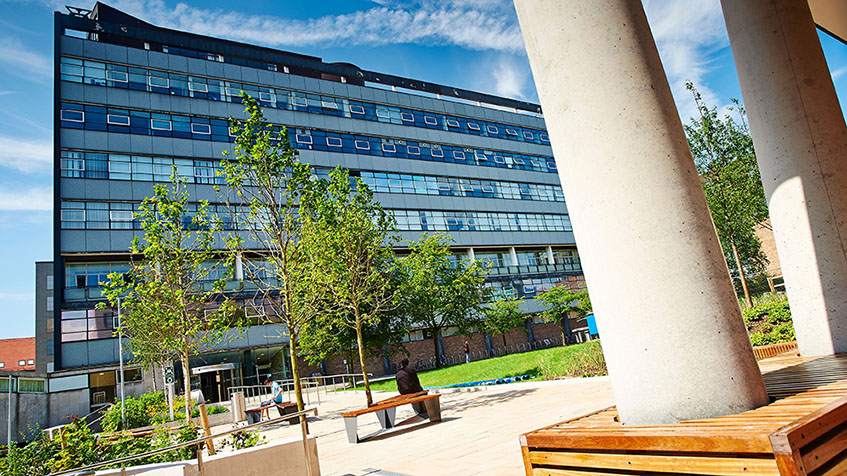
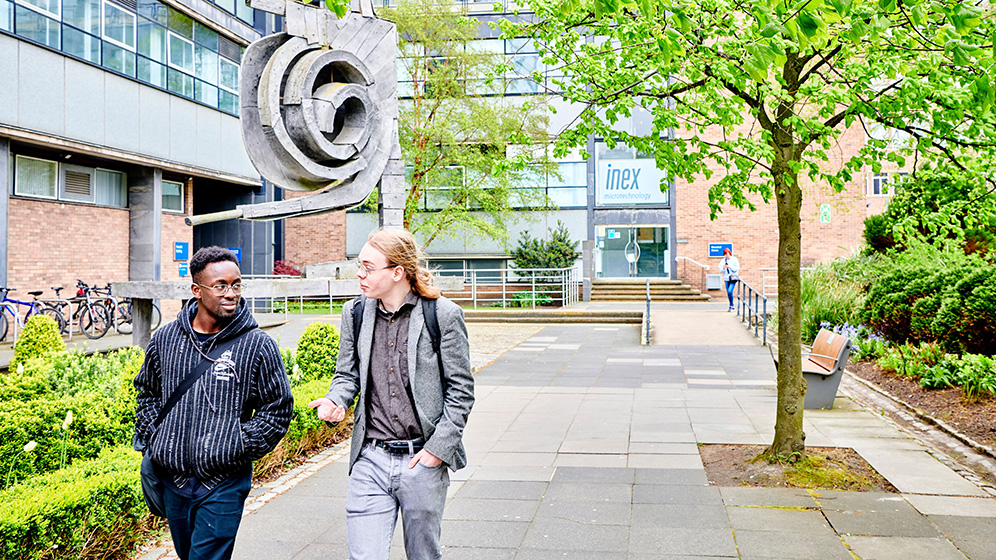
As a physics student at Newcastle University, you'll be based at our city-centre campus in the School of Mathematics, Statistics and Physics' Herschel Building.
The school has high-specification laboratory facilities equipped with leading experimental and computational physics capabilities, as well as access to world-class telescopes and space missions, such as:
- cryogenics labs
- semiconductor labs
- High-Performance Computing
- data from the Vera Rubin Telescope
- dark lab
- NASA's Kepler/K2, TESS
- JWST space telescopes ESA's PLATO space mission
The Herschel Building also has dedicated study and social spaces, and a computing area.




Tuition fees and scholarships
Tuition fees for academic year 2027-2028
| Qualification: MPhys Honours | |
|---|---|
|
Home students full time 4 years |
Tuition fees (Year 1)
£10,050 |
|
International students full time 4 years |
Tuition fees (Year 1)
32,600 |
Year abroad and additional costs
For programmes where you can spend a year on a work placement or studying abroad, you will receive a significant fee reduction for that year.
Some of our degrees involve additional costs which are not covered by your tuition fees.
Scholarships
Find out more about:
How to apply
Apply through UCAS
To apply for undergraduate study at Newcastle University, you must use the online application system managed by the Universities and Colleges Admissions Service (UCAS). All UK schools and colleges, and a small number of EU and international establishments, are registered with UCAS. You will need:
- the UCAS name and institution codes for Newcastle University (NEWC/N21)
- the UCAS code for the course you want to apply for
- the UCAS 'buzzword' for your school or college
If you are applying independently, or are applying from a school or college which is not registered to manage applications, you will still use the Apply system. You will not need a buzzword.
Apply through UCASInternational students can apply through an agent
International students often apply to us through an agent. Have a look at our recommended agents and get in touch with them.
Open days and events
UK open days
You'll have a number of opportunities to meet us throughout the year at our on-campus and virtual open days.
You'll be able to:
- explore our beautiful campus
- find out about our vibrant city
- discover what students think about studying at Newcastle
You'll also have the opportunity to speak to academic staff and find out more about the subjects you're interested in.
Find out about how you can visit Newcastle in person and virtually.
Worldwide events
We regularly travel overseas to meet with students interested in studying at Newcastle University. Visit our events calendar to find out when we're visiting your region.
Online events
Get in touch
By phone
Call us on +44 (0) 191 208 3333 and press option 1. Our opening hours are Monday to Friday 10am until 4pm.
Online
Keep updated
We regularly send email updates and extra information about the University.
Receive regular updates by email