Computing Science
Download brochure:
Computing science has revolutionised the way we work, play, communicate and do business with each other. It is a science for the future that covers all aspects of working with computers, from programming to e-commerce, games development to computer security. The School of Computing Science at Newcastle has made a long-standing contribution to the discipline, most recently including working with Microsoft and Yahoo to tighten their e-mail security. It is this research-led culture that keeps our British Computer Society (BSC)-accredited computing science and information systems degrees at the cutting edge of the subject, with industrial placement years available as part of all our degrees, helping you to hone your skills in the commercial computing world.
Why Choose Newcastle?
- Choose from final-year modules that draw heavily on our world-leading research, with particular strengths in e-science, distributed systems, bioinformatics, security, human-computer interaction (including computer graphics), and theoretical computing.
- Make your skills and experiences more relevant to industry through state-of-the-art video conferencing and collaborative learning facilities, born of our role as one of four partner institutions involved in the National Active Learning in Computing: Centre of Excellence in Teaching and Learning Project.
- Access a large network of computers, which includes specialist PC clusters running Linux and Windows, only available to students in the School of Computing Science.
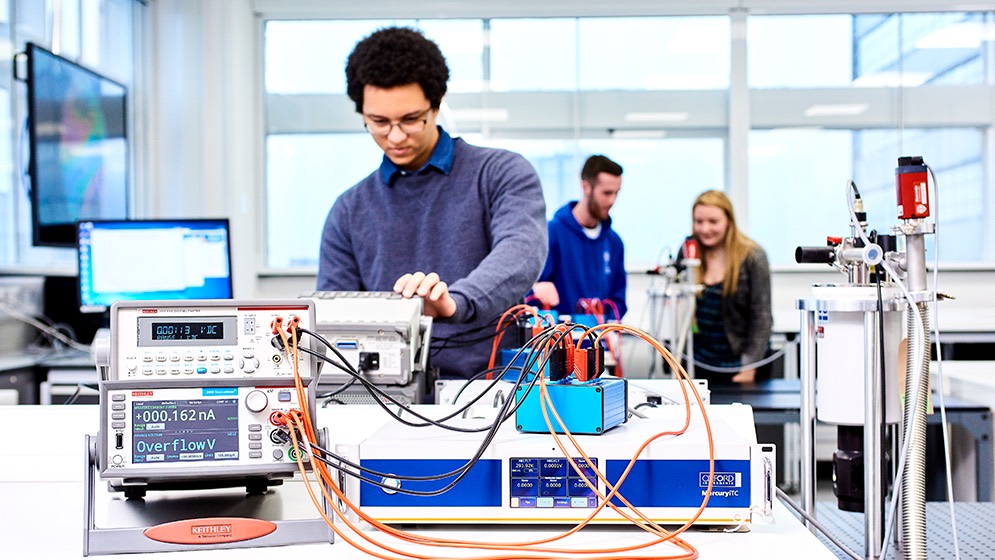
- Benefit from specialist equipment for research projects such as our £1.5 million virtual reality suite, robotics lab, motion caption suite, rapid prototyping, and surface computing facilities.
- Join a thriving digital scene in the North East, which has its own centre for digital innovation to create and develop new and existing digital media technology companies, as well as offering paid internships and networking opportunities. Various parts of our degrees also attract prizes from major companies including Accenture, British Airways, Hewlett Packard, Logica and Arjuna.
Teaching and Assessment
On average you will have around 18 hours of teaching a week through a combination of: lectures with academics; guest lectures by visiting IT professionals; tutorials where you will discuss material in groups; and supervised practical work. Practical work accounts for a significant amount of your time, up to six hours each week (though this, as with your teaching time, may vary greatly between modules). As these are full-time courses, you will be expected to supplement this with a significant level of independent reading and study throughout the course. Your practical skills will be assessed through course work, which includes team and individual project reports. Modules involving key transferable skills will be assessed through written and oral presentations. You will also sit examinations for some modules.
Careers
In the current job market, the skills developed by our Computing Science graduates enable them to obtain employment in challenging and fulfilling careers. Computing manufacturers, computer games companies, IT consultancies and software houses, for example, recruit our graduates as software engineers, web developers, programmers and analysts.
Organisations which use computers on a large scale - such as retailers, insurance companies, the electronics industry, central and local government, and management in all areas of business, also offer employment opportunities in systems design, IT technical support, information systems management and database administration.
Some of our students train as teachers in secondary or primary schools and others use the skills developed to enter careers as diverse as law, human resources, armed forces and event management.
A number of our graduates also continue with their studies as postgraduate students, specialising in areas such as bioinformatics, internet applications and computer security.
Students at Newcastle benefit from our award-winning Careers Service, which provides individual advice and information on career development and opportunities, including internships, placements and vacation work.
To find out more about how the University's Careers Service can help you make the most of your time in Newcastle and prepare you for life after graduation, go to: www.ncl.ac.uk/careers
Degrees in this area (Estimated intake: 150):
- Computing Science BSc Honours (G400)
- Computing Science (Games and Virtual Environments) BSc Honours (G450)
- Computing Science (Networked Systems and Internet Technologies) BSc Honours (G420)
- Computing Science (Software Engineering) BSc Honours (G600)
- Computing Science with Industrial Placement BSc Honours (G401)
- Computing Science with Industrial Placement (Games and Virtual Environments) BSc Honours (G451)
- Computing Science with Industrial Placement (Networked Systems and Internet Technologies) BSc Honours (G421)
- Computing Science with Industrial Placement (Software Engineering) BSc Honours (G603)
- Information Systems BSc Honours (G500)
- Information Systems (Industrial Placement) BSc Honours (G504)
- Information Systems with Business Studies BSc Honours (G5N1)
- Information Systems with Business Studies (Industrial Placement) BSc Honours (G5NC)
- Information Systems with Management BSc Honours (G5N2)
- Information Systems with Management (Industrial Placement) BSc Honours (G5NF)
You may also be interested in:
- Electronics and Computer Engineering MEng Honours (H654) BEng Honours (H652)
- Geographic Information Science BSc Honours (F862)
- Natural Sciences BSc Honours (GFC0)
Enquiries:
- Web Form: http://www.ncl.ac.uk/forms/enquiries/
- Telephone: 0191 208 3333