Security and Defence
Our research, expertise and partnerships play a crucial role in shaping a safer, more resilient future.
Our world-leading expertise in security, resilience, defence and emerging technologies helps address complex modern threats to our economic, technological, and environmental stability and social stability.
Working with a broad network of partners from industry, the armed forces and wider society, we are helping to build a safer future for everyone.
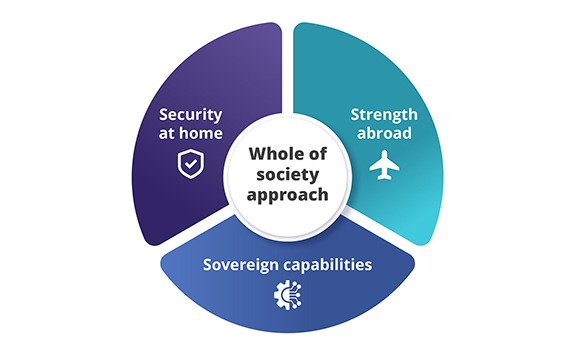
Our “whole-of-society” approach
In an age of increasing global threat and insecurity, defence has become a priority for the government and many organisations. We are bringing together science, technology, policy, and social understanding through our “whole‑of‑society” approach to security and defence.
This supports communities through geopolitical instability, cyber and technology-enabled attacks, economic and social shifts, and climate, ecosystem and resource-driven pressures.
We contribute to the three key areas of security at home, security abroad and sovereign capabilities by:
- advancing leading-edge research and innovation
- educating the workforce across security‑relevant sectors
- partnering with government, industry, and communities to tackle challenges together.
Partners in security and defence
The North East is home to a fast-growing, strategically vital Defence and Security ecosystem. Newcastle University is a founding member of the North East Regional Defence and Security Cluster.
We are signatories of the Armed Forces Covenant, committed to supporting serving personnel, veterans, and their families.
We bridge defence and study together. For example, the Hacking 4 MoD module, facilitated by the Common Mission Project, allows students to tackle real-world challenges set by the Ministry of Defence. This is run in over 20 universities across the UK.
We work closely with the armed forces through our support for three regional units:
- Northumbrian Universities Royal Naval Unit (NURNU)
- Northumbrian Universities Officer Training Corps (NUOTC)
- Northumbrian Universities Air Squadron (NUAS)
The Northumbrian Universities Military Education Committee, hosted by Newcastle University, oversees the work of these military service units and represents the collective interests of the region’s five higher education institutions, offering coordination, advice, and support.
Today, we collaborate with organisations at the forefront of defence and security - from innovative SMEs to global industry leaders, Government, the military, and other partners - working together across research, innovation, and education to strengthen capability.
Our approach to partnership and collaboration
We assess new defence and security partnerships and projects on a case-by-case basis within the framework of a number of existing policies and processes, and must comply with relevant legal, ethical and professional standards. We do not support research that is intended solely for direct offensive military activities.
Additionally, researchers and students must comply with international regulations. This could include obtaining an Export Licence when sharing information, data and equipment related to controlled technology with international partners.
You can find more detail on the process in our Ethics toolkit for Defence and Security.
Endowment Investment by the University
The University is committed to investing in a socially and environmentally responsible manner. It does not invest in companies manufacturing armaments.
More information can be found on the University’s Endowment Investment Policy.
Security and defence news

Newcastle researchers join new UK semiconductor centre
Newcastle joins a new £16.7m National ICT Knowledge Centre to strengthen the UK’s ability to design next-generation electronic systems and support the ambitions of the UK Semiconductor Strategy.

Comment: Iran war shows how AI speeds up military ‘kill chains’
Writing for The Conversation, Craig Jones and Helen M. Kinsella discuss how the use of AI in the Iran war is the latest development to have shortened the military “kill chain”.

Comment: why the Chagos Islands deal is delayed
Writing for The Conversation, Sue Farran and Colin Murray explain why the Chagos Islands deal is delayed and why Mauritius is threatening to sue the UK government
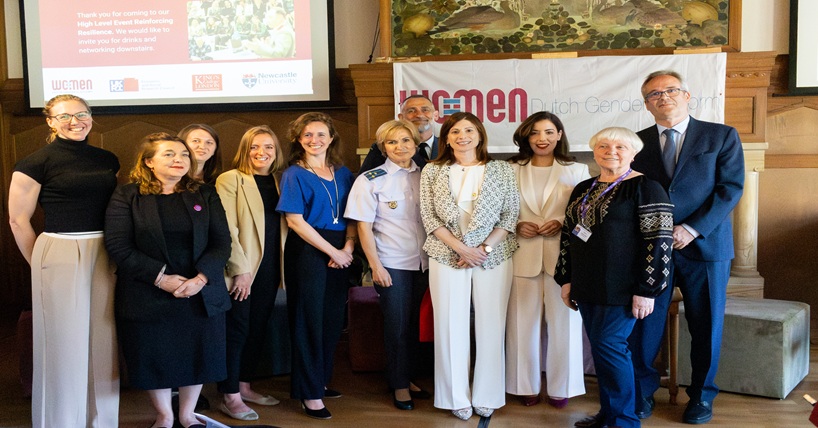
New guide offers tools to protect women’s rights during conflict
A guide, co-authored by Newcastle University experts, aims to equip military leaders, policymakers, and civil society advocates with tools to protect women's rights in areas experiencing conflict.

Expert helps shape NATO report on climate change and global security
Professor Oliver Heidrich has provided expert insight into a NATO report examining how climate change is a threat multiplier that is reshaping global security challenges.

Covid inquiry hears evidence from public health expert
A world-leading expert on health inequalities at Newcastle University will be presenting further evidence to the independent public inquiry into the Covid pandemic today.
Security at home
Building resilient places
Our research and education are strengthening national resilience in areas such as:
- cyber security
- public health
- energy
- infrastructure
- food security
We partner with government, industry, local resilience forums, and communities to improve preparedness for crises and strengthen national capacity to respond to evolving threats.
Cyber security
We have unique physical and virtual testing facilities. They contribute to cyber resilience through world‑class research in:
-
secure software systems
-
cryptography
-
human‑centred cyber‑defence
We've been an Academic Centre of Excellence in Cyber Security Research since 2013. This work supports the National Cyber Security Centre.
Public health including antimicrobial resistance
We are enabling resilient health systems through integrated expertise in:
-
epidemiology
-
data‑driven health analytics
-
health‑systems modelling
-
and community‑based interventions
This work improves preparedness, response, and long‑term population wellbeing. Our biomedical research and microbiology expertise are developing an understanding and solutions to antibiotic resistance.
Security abroad
Global partnerships for collective security
Our global partnerships strengthen collective security and contribute to sustainable and economic development overseas.
International research collaborations, transnational education and capacity‑building programmes in areas such as:
- climate resilience
- public health
- digitisation
- sustainable technologies
- conflict resolution
- disinformation
These support stability and economic development, which contribute to global peace and prosperity.
Post‑war reconciliation and recovery
We contribute expertise to peacebuilding and reconstruction. Our research focuses on social repair, governance reform, and inclusive recovery after conflict. This includes our partnership with Ukraine to support the training of engineers to rebuild critical infrastructure.
Protecting heritage in conflict
Heritage provides a sense of place, identity, and belonging. Protection of heritage is inherently linked to the protection of people. We work with the heritage, military, and humanitarian sectors to conserve heritage during peacetime. This work ensures its protection during conflict or following a natural disaster.
Sovereign capabilities
Leading-edge science, engineering and technology
In partnership with industry and Government, we directly support the UK’s long‑term:
- technological
- industrial
- strategic capabilities
Our work is helping build the UK’s industrial base in:
- marine
- aerospace
- communications
- advanced manufacturing
We are also developing capabilities in AI, biotechnology and quantum computing. These areas drive innovation across defence, national infrastructure, industry and allied collaboration.
Every year, we train thousands of talented and highly skilled graduates in science, engineering and computer science. Through developing pioneering researchers, we are helping to underpin future technology breakthroughs.
Maritime and offshore engineering
Newcastle University provides nationally important maritime and offshore engineering expertise.
From floating and fixed platforms, subsea systems, ship design, operations and maintenance to offshore energy systems and maritime autonomy to enable resilient offshore energy and maritime infrastructure.
Digital and AI
Newcastle University is a leading force in trustworthy, human‑centred, and secure AI.
This accelerates digital innovation and the responsible adoption of AI across sectors, including:
- healthcare
- finance
- defence
- environmental risks
We are playing a central role in the UK’s new sovereign AI infrastructure based in Newcastle.