Media and Public Relations MA
- Study mode and duration
- Course code
- 4076F,4076P
- Fees (per year)
- Typical entry requirements
-
View full entry requirements - Course delivery
- On Campus
Course information for entry year:
Your Future, Re-Designed
This course is currently undergoing an exciting transformation to embed richer encounters with industry, professional practice and society. As we redesign our curriculum to reflect emerging opportunities, future-facing themes and new ways of learning, some elements of this course may evolve to match the world you’re stepping into. While this transformation is underway, modules, learning experiences and assessment approaches may be updated. We’re committed to ensuring the quality, relevance and ambition of your learning journey, and we’ll keep you informed as soon as new information is ready.
Overview
Your Future, Re-Designed
This course is currently undergoing an exciting transformation to embed richer encounters with industry, professional practice and society. As we redesign our curriculum to reflect emerging opportunities, future-facing themes and new ways of learning, some elements of this course may evolve to match the world you’re stepping into.
While this transformation is underway, modules, learning experiences and assessment approaches may be updated. We’re committed to ensuring the quality, relevance and ambition of your learning journey, and we’ll keep you informed as soon as
Our MA in Media and Public Relations combines hands-on public relations practice with in-depth media analysis. On our programme you'll explore the intersection of media, culture, politics and business and prepare for a career in a fast-evolving industry.
This Master's in Media and Public Relations is for:
- students who have Public Relations (PR) knowledge through undergraduate studies or voluntary work
- PR professionals wishing to develop their academic knowledge and research methods
Teaching draws on the research of specialists in media, communication and cultural studies.
Through the course you'll gain:
- a critical understanding of media, culture and society
- knowledge to theorise and analyse media and public relations
- knowledge of media law and public relations regulations in a transnational context
- an understanding of the strengths and weaknesses of different types of data dissemination
- a critical understanding of the strategic and ethical use of AI within the public relations industry.
You'll also develop valuable professional skills, such as:
- analytical and critical skills to assess and conduct research in the field of media and PR
- the ability to deliver and evaluate a PR event in the public, private and voluntary sectors
- skills to set up a campaign network and deliver PR campaign messages
- skills to produce effective press releases
- written materials for traditional and digital media
Important information
We've highlighted important information about your course. Please take note of any deadlines.
Please rest assured we make all reasonable efforts to provide you with the programmes, services and facilities described. However, it may be necessary to make changes due to significant disruption, for example in response to Covid-19.
View our Academic experience page, which gives information about your Newcastle University study experience for the academic year 2025-26.
See our terms and conditions and student complaints information, which gives details of circumstances that may lead to changes to programmes, modules or University services.

There is so much I enjoy about my course: the modules, practical tasks and assignments. I love that I have opportunities to express my thoughts and think critically at the same time. I’m gaining vital experience alongside international students.
Quality and ranking
Professional accreditations are reviewed regularly by professional bodies to ensure they meet the latest industry practices and regulatory standards. This keeps your degree rigorous, relevant, and highly valued by employers, providing a clear pathway into your chosen career.
If you are studying an accredited degree and considering a career in Europe after graduation, it is important to stay informed about international standards. The best resource for current information is the UK Government's guidance on recognition of UK professional qualifications in EU member states.
This official resource provides essential details on:
- whether your profession is regulated in another country.
- the specific steps you need to take to practice abroad.
- which organisations you should contact to begin the process.
Our students


Aytach from Azerbaijan
Media and Public Relations MA
There is so much I enjoy about my course: the modules, practical tasks and assignments.


Christine from Germany
International Multimedia Journalism MA
Everyone I have encountered here so far has been nothing but kind and helpful. It’s my favourite thing about studying here.


Kanupriya from India
International Multimedia Journalism MA
I really enjoyed being taught by my professors. They provided real-world examples and know what you need to become a successful journalist.

Jebby from India
Music Education MA
This course is for anyone who wants to think deeply about music teaching, learning, pedagogy, creativity, and the wider role of music in society.

Omkar from India
Media and Public Relations MA
Newcastle University is special because it became a place where I felt included, valued and proud of what I contributed.


Alexandra from United Kingdom
Fine Art MA
What I love most about Newcastle University is the sense of community and the incredible range of opportunities available.
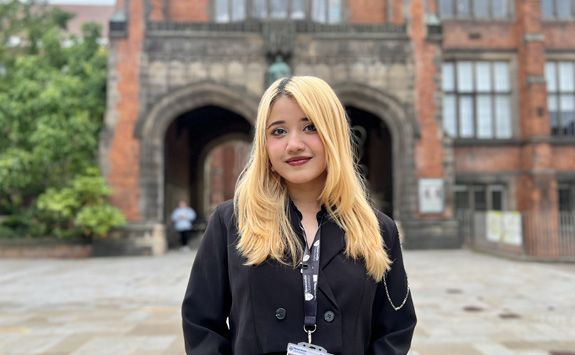
Damia from India
Media and PR MA
What stands out most is how practical and well-structured the course is, the modules feel relevant to the real world.


Gloria from Ghana
Media and Public Relations MA
Engaging in media-related projects has helped me build confidence, teamwork, leadership, and networking skills.
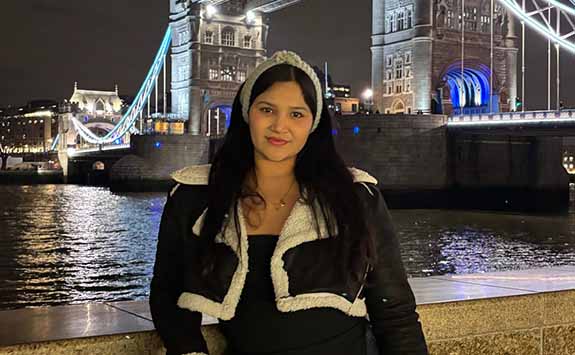

Fabiana from Peru
Media and PR MA
This degree has helped me to think bigger, trust my own voice, and feel like my ideas can actually mean something.
What you'll learn
You'll build knowledge, understanding and skills through compulsory and optional modules. You'll carry out independent research into a theme or issue relating to media and public relations for your dissertation.
Part-time students take 80 credits of compulsory modules in year one and 100* credits in year two.
* 40 credits of optional modules and the 60 credits research dissertation or 60 credits final media project.
Modules
The module information on our course pages is intended to provide an example of what you will study.
Our teaching is informed by research. Course content changes periodically to reflect developments in the discipline, the requirements of external bodies and partners, and student feedback.
Full details of the modules on offer will be published through the Programme Regulations and Specifications ahead of each academic year. This usually happens in May.
Some courses have optional modules. Student demand for optional modules may affect availability.
| Compulsory Modules | Credits |
|---|---|
| Media and Promotional Cultures | 20 |
| Researching Media and PR | 20 |
| Strategies and Management in PR | 20 |
| Public Relations Theory and Concepts | 20 |
You also undertake one of the following modules:
| Compulsory modules | Credits |
|---|---|
| Communications and Cultural Industries Project: Research and Professional Development | 60 |
| MA Media and PR Final Project | 60 |
How you'll learn
You'll be taught using a range of methods, including:
- online learning materials
- seminars
- workshops
- online discussion groups
You're expected to work independently and in groups. You'll:
- read widely
- participate actively in discussions
- develop topics for investigation based on advice from tutors
Depending on your modules, you'll be assessed through a combination of:
- Case study
- Computer assessment
- Dissertation
- Essay
- Oral presentation
- Portfolio
- Report
- Research proposal
- Written exercise
Throughout your studies, you’ll have access to support from:
- academic staff
- academic advisers and research supervisors
- our University Student Services Team
- student representatives
- peers
You'll also be assigned an academic member of staff, who will be your academic adviser throughout your time with us. They can help with academic and personal issues.
Your teaching and learning is also supported by Canvas. Canvas is a Virtual Learning Environment. You'll use Canvas to submit your assignments and access your:
- module handbooks
- course materials
- groups
- course announcements and notifications
- written feedback
Our experienced professional teaching team includes colleagues with international background and a variety of experience in the PR and communication industry.
Each year, we host exclusive masterclasses with expert speakers, including Professor Timothy Coombs who:
- is a globally-recognised scholar of issues and crisis management and an ICA fellow.
- is editor for Corporate Communications: An International Journal
- is an author of several PR textbooks and has numerous research that has appeared in high impact PR and Communication journals
- coined the Situational Crisis Communication Theory (SCCT) which is recognised as one of the most influential theories in crisis communication
- has works that have been at the forefront of establishing crisis communication as an identifiable research field within corporate communications
Entry requirements
The entrance requirements below apply to 2027 entry.
Our entry requirements and other information will be finalised in September 2026.
Qualifications from outside the UK
English Language requirements
Admissions policy
This policy applies to all undergraduate and postgraduate admissions at Newcastle University. It is intended to provide information about our admissions policies and procedures to applicants and potential applicants, to their advisors and family members, and to staff of the University.
University Admissions Policy and related policies and procedures
Credit transfer and Recognition of Prior Learning
Recognition of Prior Learning (RPL) can allow you to convert existing relevant university-level knowledge, skills and experience into credits towards a qualification. Find out more about the RPL policy which may apply to this course
Pre-Master’s and English Language courses
Need an alternative route to study this course? Our International Study Centre offers Pre-Master’s degrees and English language courses to prepare you for study.
Your future
Careers
We'll equip you with the skills and knowledge needed for a career in the Media or Public Relations. Our course attracts graduates from across the globe and students are given the opportunity to build a portfolio of work that translates globally. On successful completion of the course students can be employed in the following roles:
- Public Relations Officer
- Events Coordinator
- Social Media Manager
- Communications Specialist
- Publicist
- Copywriter
- Media director
- Brand Manager
- Client Services Manager
- Digital Marketing Manager
- Media Researcher
- Public Affairs Consultant
- Crisis Communications Consultant
- Strategic Advisor
- Internal Communications Manager
- Employee Engagement Manager
As an MA Media and Public Relations student at Newcastle University, you'll develop a wide range of transferable skills. These range from presentation and research skills to teamwork and project management, which are highly sought after by employers.
Further Study
This Media and Public Relations MA provides a route into PhD level study.
Our Careers Service
Our expert Careers Service is here to help you take the next steps in your professional life. We will support you while you’re studying with us and for up to three years after you graduate.
You will have access to expert one-to-one advice and guidance through our campus careers centre and online, along with digital resources, workshops, networking opportunities, and careers and recruitment events.
We’ve been awarded 5 QS Stars for Student Employability (2025). Many of our degrees are shaped by strong links with national and international businesses. We are committed to helping you access real-world experience opportunities and develop key skills through paid work placements and internships.

It was amazing to have such a great mentor who taught me lots and opened plenty of doors for me when it came to graduating.

Facilities
Most of the teaching and learning on this course will take place in-person in the Armstrong building.
The Armstrong building includes:
- lecture theatres
- seminar rooms
- PC clusters
- student lounges
Fees, Funding and Scholarships
Tuition fees for 2027 entry (per year)
As a general principle, you should expect the tuition fee to increase in each subsequent academic year of your course, subject to government regulations on fee increases and in line with inflation.
Depending on your residency history, if you’re a student from the EU, other EEA or a Swiss national, with settled or pre-settled status under the EU Settlement Scheme, you’ll normally pay the ‘Home’ tuition fee rate and may be eligible for Student Finance England support.
EU students without settled or pre-settled status will normally be charged fees at the ‘International’ rate and will not be eligible for Student Finance England support. You may be eligible for a scholarship worth 25% off the international fee. Search our funding database.
If you are unsure of your fee status, check out the latest guidance.
Scholarships
We support our EU and international students by providing a generous range of Vice-Chancellor's automatic and merit-based scholarships. See our searchable postgraduate funding page for more information.
Search for funding and scholarships
Find funding available for your course
What you're paying for
Tuition fees include the costs of:
- matriculation
- registration
- tuition (or supervision)
- library access
- examination
- re-examination
- graduation
Find out more about:
If you are an international student or a student from the EU, EEA or Switzerland and you need a visa to study in the UK, you may have to pay a deposit.
You can check this in the How to apply section.
If you're applying for funding, always check the funding application deadline. This deadline may be earlier than the application deadline for your course.
For some funding schemes, you need to have received an offer of a place on a course before you can apply for the funding.
How to apply
Using the application portal
The application portal has instructions to guide you through your application. It will tell you what documents you need and how to upload them.
You can choose to start your application, save your details and come back to complete it later.
If you’re ready, you can select Apply Online and you’ll be taken directly to the application portal.
Alternatively you can find out more about applying on our applications and offers pages.
Apply Online
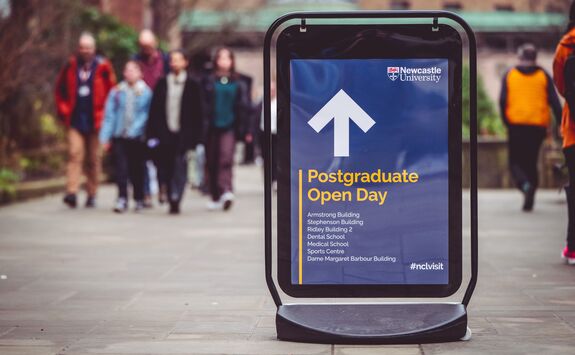
Open days and events
Find out about how you can visit Newcastle in person and virtually
Overseas events
We regularly travel overseas to meet with students interested in studying at Newcastle University.
Get in touch
Questions about this course?
If you have specific questions about this course you can contact:
Anne-Marie Lacey
Email: anne-marie.lacey@ncl.ac.uk
School of Arts & Cultures
Enquiries
If you've got a question about your application, send us an enquiry via the application portal you applied through.
If you haven't applied yet, or have a general enquiry, you can send your questions via our enquiry form.
Keep updated
We regularly send email updates and extra information about the University.
Receive regular updates by email
Chat to our students
Social media
Get involved with the School of Arts and Cultures.
#WeAreNCL on Twitter and follow @newcastleuniversity on Facebook