Law (Graduate Entry) LLB Honours
2027 entry information
- Study mode and duration
- Full time: 2 years
- UCAS code
- M102
- UCAS institution name and code
- NEWC / N21
- Tuition fees (Year 1)
-
FT Home: £10,050
FT International: £ Scholarships available - Typical entry requirements
-
A-Level:
IB: points
View alternative offers - Course delivery
- On Campus
- Professional accreditation and recognition
Course overview
Our Graduate LLB is an accelerated law degree designed for graduates from any non-law backgrounds, offering a faster route to legal qualification in just two years.
Building on your previous academic experience, you'll attend bespoke graduate workshops that will allow you to maximise your skills development and prepare you for the job market and be supported through mentorship sessions delivered by our Canadian alumnus.
You’ll develop practical legal skills in:
- Problem-solving
- Legal research
- Writing and drafting for legal and non-legal audiences
- Interviewing
- Advising
- Mooting and advocacy
You'll explore how law is created, interpreted and applied in society and study core legal subjects including: contract law, criminal law, public law, tort law, land law, equity and trusts.
Alongside the core foundations of legal knowledge, you'll benefit from 80 credits of optional modules, giving you more opportunity to tailor your degree than many comparable two-year law programmes.
Explore specialist areas such as:
- Company Law
- Family Law
- Public International Law
- Law and Gender
- Legal Theory
- International Arbitration
- Global Security Law
Beyond the classroom, you'll also have opportunities to enhance your experience. You'll do this through mooting and advocacy competitions, pro bono work, research projects and student-led legal activities.
By the time you graduate, you'll have a rigorous legal education, advanced analytical and communication skills, and practical legal experience.
All of this will prepare you not only for careers in law, but also in business, finance, government, policy, international organisations and many other sectors.
Quality and ranking
Professional accreditation and recognition
Professional accreditations are reviewed regularly by professional bodies to ensure they meet the latest industry practices and regulatory standards. This keeps your degree rigorous, relevant, and highly valued by employers, providing a clear pathway into your chosen career.
If you are studying an accredited degree and considering a career in Europe after graduation, it is important to stay informed about international standards. The best resource for current information is the UK Government's guidance on recognition of UK professional qualifications in EU member states.
This official resource provides essential details on:
- whether your profession is regulated in another country.
- the specific steps you need to take to practice abroad.
- which organisations you should contact to begin the process.
Our students
What you'll learn
Modules
The information below is intended to provide an example of what you will study.
Most degrees are divided into stages. Each stage lasts for one academic year, and you'll complete modules totalling 120 credits by the end of each stage.
Full details of the modules on offer will be published through the Programme Regulations and Specifications ahead of each academic year. This usually happens in May.
Our teaching is informed by research. Course content may change periodically to reflect developments in the discipline, the requirements of external bodies and partners, and student feedback.
You’ll build a strong foundation in legal knowledge in Legal Institutions and Methods, Contract Law, Criminal Law, Public Law, and UK & EU Law, alongside an optional module in Law and Ethics or Global Law.
At the same time, you'll develop essential skills in legal research, analysis, problem-solving and legal reasoning, helping you make a successful transition into the study of law.
Modules
You will take all of the following modules:
| Compulsory modules | Credits |
|---|---|
| Introduction to Public Law (Graduate) | 20 |
| Legal Institutions and Methods (Graduate) | 20 |
| Contract Law (Graduate) | 20 |
| Criminal Law (Graduate) | 20 |
| UK & EU Law (Graduate) | 20 |
You will take 20 credits from the following optional modules:
| Optional modules | Credits |
|---|---|
| Introduction to Global Law | 20 |
| Law and Ethics (Graduates) | 20 |
Modules
You'll complete the foundations of legal knowledge through Land Law, Tort Law, and Equity and Trusts, while choosing from a range of specialist optional modules to explore areas that match your legal interests.
You may also choose to culminate your studies with a Dissertation on a legal topic of your choice.
Modules
You will take all of the following compulsory modules:
| Compulsory modules | Credits |
|---|---|
| Land Law (Graduate) | 20 |
| General Principles of Tort (Graduate) | 20 |
| Equity and Trusts (Graduate) | 20 |
You will take 20 credits of optional modules in Semester 1 and 40 credits of optional modules in Semester 2, normally selected from the list set out below:
| Optional modules | Credits |
|---|---|
| Company Law | 20 |
| Environmental Law | 20 |
| Evidence | 20 |
| Public International Law | 20 |
| Medicine, Law and Bioethics | 20 |
| The Law of Succession | 20 |
| Legal Theory | 20 |
| Family Law | 20 |
| Law and History | 20 |
| Law and Gender | 20 |
| Global Intellectual Property Law and Policy | 20 |
| Dissertation in Law | 40 |
| Global Security Law | 20 |
| Principles of International Arbitration | 20 |
Modules
We base these figures and graphs on the most up-to-date information available to us. They are based on the modules chosen by our students in 2025-26.
Teaching time is made up of:
- scheduled learning and teaching activities. These are timetabled activities with a member of staff present.
- structured guided learning. These are activities developed by staff to support engagement with module learning. Students or groups of students undertake these activities without direct staff participation or supervision
How you'll learn
Teaching methods
Assessment methods
You'll be assessed through a combination of:
-

Assessments
-

Coursework
-
Examinations – practical or online
-

Group work
-

Practical sessions
-

Presentations
-

Reflective report/journal
Skills and experience
Support
Newcastle Law School has a long history of providing a comprehensive support network for students.
In your first year, you will be assigned an academic adviser. This academic member of staff will guide your studies, with weekly office hours when you can drop in for advice. This relationship ensures that your reference will be prepared by someone who knows you personally.
A fellow student will also be assigned as your peer mentor. They will help ensure that the transition from school/college to university, as well as the transitions between different years at university, are as seamless as possible.
Student mentors will give you guidance on everything from how to get the most out of lectures, to how best to enjoy Newcastle as a city.
Opportunities
Build your professional network
The Law School has its own Professional Mentoring Network (ProMNet). Here you can connect with legal practitioners and professionals from a range of sectors.
You'll also receive dedicated mentoring, with insights from a Newcastle graduate who's gone on to build successful legal careers in Canada.
Our communities
We have an active student community, with three student-led societies – Law Society, Bar Society and ELSA. These offer further opportunities to make connections and hone your practical legal skills.
The Law Society hosts a variety of events throughout the year. These include careers sessions, legal competitions and social events.
The Bar Society runs various competitions including advocacy, mooting and please in mitigation. It offers mentoring and networking opportunities for students interested in a career as a Barrister.
The European Law Students’ Association (ELSA) is an international, independent, non-political, non-profit-making organisation. It is run by and for students. ELSA offers you the perfect platform to develop new and existing skills and meet fellow students and legal professionals throughout Europe.
You may be interested in
Additional information
Entry requirements
The M102 Law (Graduate Entry) LLB Honours programme is open to graduates who have achieved (or expect to achieve) at least a 2:2 Honours degree.
Canadian applicants
Typically, we recognise the following scores from a Canadian Bachelor degree as comparable to a UK 2:2:
- GPA 2.7/4.0 or 6.0/9.0 or 7.0/12.0
- or B-
- or 70%
Other international qualifications
If you are applying with another international degree, please contact ug-admissions@newcastle.ac.uk to check that your qualification is accepted.
English Language requirements
Applicants whose first language is not English require a minimum score of IELTS 6.5 or equivalent including 6.0 in each of the four elements of the test.
Read more about UK visas and immigration requirements
University admissions policy
This policy applies to all undergraduate and postgraduate admissions at Newcastle University. It is intended to provide information about our admissions policies and procedures to applicants and potential applicants, to their advisors and family members, and to staff of the University.
University Admissions Policy and related policies and procedures
Your future
The Newcastle LLB gives you a diverse range of skills that will prepare you for a number of careers. Our graduates are sought after by a range of high-profile employers.
Many of our graduates go on to qualify as solicitors or barristers. Some choose to enter private practice. Others join organisations such as the Civil Service, local authorities or large companies.
Practicing Law in the UK
If you're looking to pursue a career as a solicitor in the UK you'll need to pass the two stages of the Solicitors Qualifying Examination (SQE). You'll also need to complete two years of work experience.
To qualify as a Barrister you'll need to pass the Bar Practice Course (BPC) before completing a final practical stage of training: pupillage.
You can study your SQE or BPC with the University of Law at Newcastle University.
Practicing Law in Canada
If you're looking to practice law in Canada, after graduation, you'll need to apply to the National Committee on Accreditation (NCA).
Your Newcastle degree covers the foundations of legal knowledge common to the UK and Canada, but the NCA may require completion of additional examinations or coursework related to Canadian law.
On completion, graduates will be able to progress to the licensing process in their chosen Canadian province.
Careers support
As a student on our programme you'll have access to:
- our dedicated careers advisor
- talks on the profession by practising lawyers
- gaining experience via one of our five award-winning pro bono schemes
- legal internship applications
- potential employers at our annual Law School Careers Fair
Our Careers Service is one of the largest and best in the country, and we have strong links with employers. We provide an extensive range of opportunities to all students through our ncl+ initiative.
Facilities and environment
Facilities
Situated on the eastern side of the city campus, the Law School offers you a great sense of community. It has everything you need as a law student:
- a 270 seater law lecture theatre
- computer cluster
- seminar rooms
The student common room is a great place to relax and catch up with fellow students. As our academic and support staff are all based in the same building, you'll find it easy to seek advice whenever you need it.
We also have a dedicated mooting room, which provides the perfect environment to develop your advocacy skills.

Mooting room

Law social spaces

Law lecture theatre

Students playing pool in the Law common room
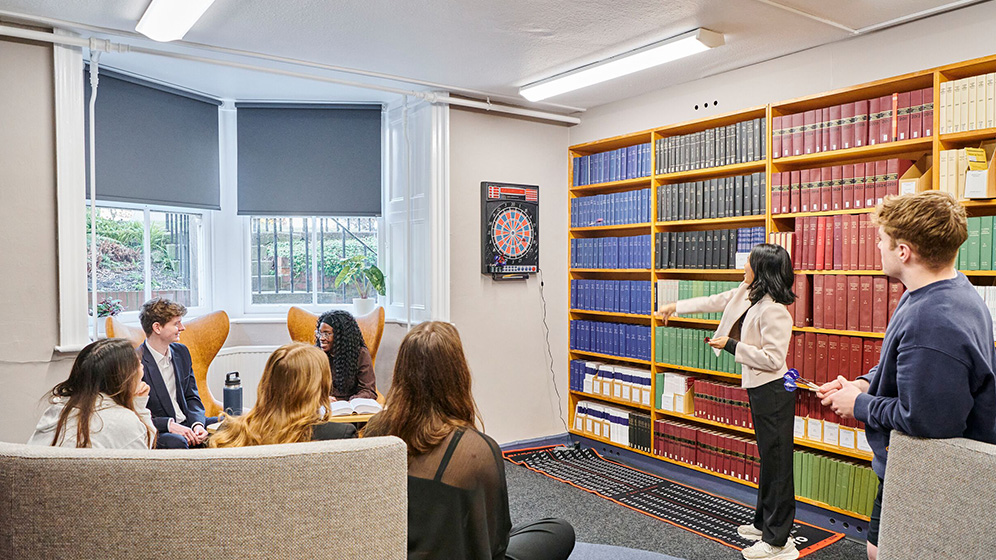
Students playing darts in the Law common room

Study pods in the Law School
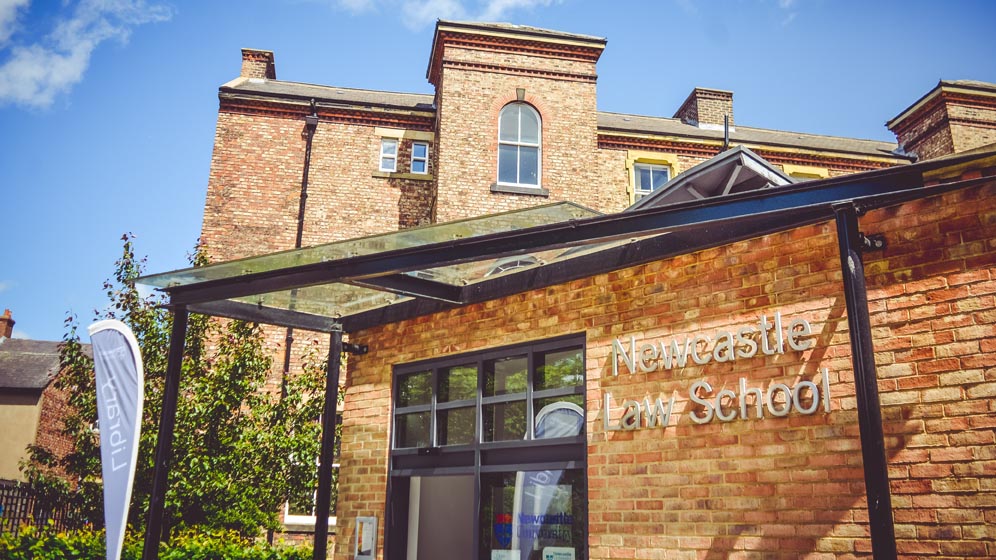
Newcastle Law School building
Tuition fees and scholarships
Tuition fees for academic year 2027-2028
| Qualification: LLB Honours | |
|---|---|
|
Home students full time 2 years |
Tuition fees (Year 1)
£10,050 |
|
International students full time 2 years |
Tuition fees (Year 1)
|
Year abroad and additional costs
For programmes where you can spend a year on a work placement or studying abroad, you will receive a significant fee reduction for that year.
Some of our degrees involve additional costs which are not covered by your tuition fees.
Scholarships
Find out more about:
How to apply
Apply through UCAS
To apply for undergraduate study at Newcastle University, you must use the online application system managed by the Universities and Colleges Admissions Service (UCAS). All UK schools and colleges, and a small number of EU and international establishments, are registered with UCAS. You will need:
- the UCAS name and institution codes for Newcastle University (NEWC/N21)
- the UCAS code for the course you want to apply for
- the UCAS 'buzzword' for your school or college
If you are applying independently, or are applying from a school or college which is not registered to manage applications, you will still use the Apply system. You will not need a buzzword.
Apply through UCASInternational students can apply through an agent
International students often apply to us through an agent. Have a look at our recommended agents and get in touch with them.
Open days and events
UK open days
You'll have a number of opportunities to meet us throughout the year at our on-campus and virtual open days.
You'll be able to:
- explore our beautiful campus
- find out about our vibrant city
- discover what students think about studying at Newcastle
You'll also have the opportunity to speak to academic staff and find out more about the subjects you're interested in.
Find out about how you can visit Newcastle in person and virtually.
Worldwide events
We regularly travel overseas to meet with students interested in studying at Newcastle University. Visit our events calendar to find out when we're visiting your region.
Online events
Get in touch
By phone
Call us on +44 (0) 191 208 3333 and press option 1. Our opening hours are Monday to Friday 10am until 4pm.
Online
Keep updated
We regularly send email updates and extra information about the University.
Receive regular updates by emailChat to our students
Any specific course-related info. The component with also include general university contact info.