Social Justice Through Research
Our researchers work on numerous research projects on themes relating to social justice. Much of this research is conducted with external organisations as collaborating partners. Our research doesn’t simply document urgent social issues, but finds and tests solutions based on real world learning from our partners and the communities affected.
Carving out Climate Testimony
Newcastle Geographer Professor Jen Bagelman’s work demonstrates the vital relationship between social justice and climate change.
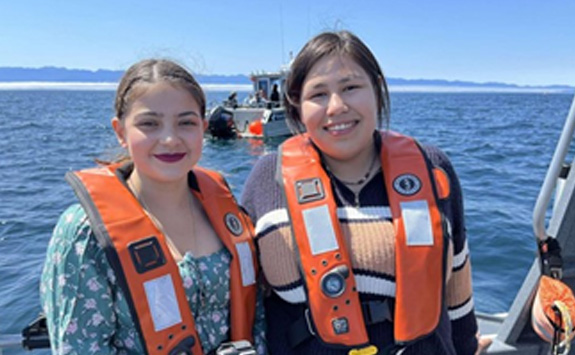
Carving out Climate Testimony examines increasing mental health risks facing young people in Inuit Nunangat (Arctic Canada). These risks are shaped by the legacies of colonialism, and climate change impacts of shrinking sea ice, thawing permafrost and breaching of land and settlements. Climate change has a disproportionate impact on the Arctic, with temperatures rising at more than twice the global average, affecting Inuit livelihoods, health, and wellbeing.
Prof Bagelman led the collaboration with CoPI Karla Williamson (University of Saskatchewan), Newcastle colleagues Rachel Pain, Ingrid Medby and Louise Callard, and six Inuvialuit young community leaders who drove the project’s questions and methods. Through traditional practices of unikkausivut (storytelling) and modern media such as film, youth documented their experiences of climate change and vision for alternative futures. They share their insights with policymakers and knowledge leaders including Environment and Climate Change Canada, scientists contributing to the IPCC, and ArcticNet.
Putting anti-racism into teaching training
In her critical analysis of education policy, Professor Heather Smith challenges inaction on racism. Her research reveals a disconnect between what is said and what is done in education policy work. The research found that anti-racism work in education is often obscured. Statistics are often manipulated in a complex way.
Professor Smith has worked with Professor Vini Lander to create a research-informed anti-racism framework for ITE/T in England. The framework counters the deracialisation of initial teacher education (ITE) policy. The framework is now being used nationally across the sector. A letter to the government endorsing the framework was signed by over 140 ITE providers in England. The letter was also signed by CEOs, Chairs, Directors and Chief Officers of professional education bodies, anti-racism charities, and the national education union.
Influenced by the framework and research, Citizens UK, in their manifesto for change, called for “statutory training in racial equity and relevant frameworks for school leaders and governors, teachers across career phases and the broader school staff body.”
Children co-producing theatre about bugs
Dr Vivek Nityananda is a Social Justice Advisory Group member. His research and outreach combine issues of social and environmental justice.
The Vanishing Act is a family-friendly cabaret show in collaboration with Cap-A-Pie Theatre. It communicates findings about the recent decline in insect numbers and the unique capabilities of insects. It aims to make people more aware of insects and the problems they face by informing them about current research. In turn, we hope it will lead to changes in attitudes towards insects and behavioural change to help conserve them.
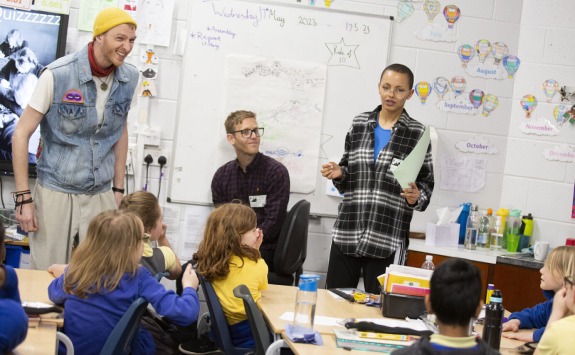
The show was developed through workshops with young people at primary schools in Newcastle. They provided inspiration for song lyrics, script additions, set design, costume design and movements. After the workshops, the children had a better understanding and increased positive respect for insects.
The show was staged at one of the primary schools and at the Star And Shadow Cinema. Audience members said that the show increased their knowledge and understanding of insects, the impact of humans on biodiversity, how to change their own practices and how to communicate about the subject.
Social prescribing action research
The SPACE Pilot (Social Prescribing And Community rEsources for Children and Young People) is a partnership project between Newcastle University, Ways to Wellness and the Great North Children’s Hospital.
Our link workers offer non-medical support to complement the work of clinicians. The project helps children with chronic complex needs who experience health inequalities and unmet social need. They work with the whole family, helping them to feel more confident in managing their health and wellbeing.
Link workers ask what matters most to each family member and support them to achieve their goals. Examples include:
- involvement in community groups and activities
- signposting to advice about benefits and grants
- accessing emotional and practical support
The project explores how social prescribing can be adapted for children and their families when accessing hospital services.
“[I]t is good to have somebody who is there who is able to have the time and resources to… give you that little bit of information and advice. Because it’s so lacking, it really is… I think it’s a very, very valuable service.” SPACE Pilot client

Tackling Islamophobia
Professor Peter Hopkins has spent more than 20 years exploring how racism and Islamophobia impact people from diverse ethnic and religious backgrounds.
Findings of his co-authored report about Muslim youth and political participation in Scotland led to him setting up of Scotland’s first ever Cross-Party Group on Tackling Islamophobia with Anas Sarwar MSP. Through this group, Professor Hopkins led the first-ever Public Inquiry on Islamophobia in Scotland, whose findings were widely endorsed by MSPs.
Zara Mohammed, Secretary-General of the Muslim Council of Britain commented that “if acted upon by the Scottish Government, [it] would prove effective in tackling the scourge of Islamophobia across sectors of society and make Scotland a model of cohesion and equality. Islamophobia has become increasingly pervasive, and its impact on the lived experience of everyday Scottish Muslims is profound. The time to act is now.”
Professor Hopkins also provided advice to an All-Party Parliamentary Group (APPG) of UK MPs about British Muslims’ definition of Islamophobia, reflecting his research findings that that other ethnic groups as well as Muslims experience Islamophobia.
Misrepresentation of Muslims in the media has also been a key issue raised by participants in research about Islamophobia. In 2019, Professor Hopkins worked with Uzma Mir to develop Scotland’s first set of guidelines for reporting on Islam and Muslims.
Co-creating knowledge on maternal mental health
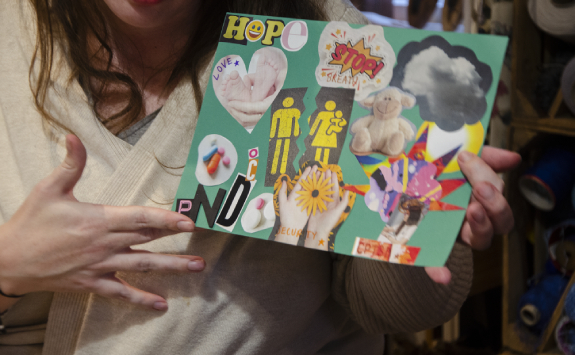
Dr Caroline Claisse works with diverse groups of mothers to improve antenatal care. She aims to raise awareness and promote listening with communities whose voices are often unheard or excluded from research and practice. The research seeks to understand the barriers and challenges faced by women experiencing complex social factors and health inequalities.
One project works with Roma and Arabic speaking women in Gateshead to identify important information for supporting antenatal care. A second project is a collaboration with the Happy Mums Foundation in North Cumbria. They engage with mums and mums-to-be who have experienced homelessness, the asylum system, criminal justice system, from LGBTQ+ communities, Black and Brown mums and mums who are neurodivergent. The research is co-created with community partners, and uses accessible hands-on creative activities in order to open up issues that can be hard to talk about.
Research outputs include considerations for thinking differently about how services should be designed and offered to meet their needs, whilst informing best practice for participatory community-based research in which community engagement of this nature builds community as a vehicle for change.
“Previously, Happy Mums’ involvement with research had been limited to that of passive participant or conduit of information… This project represented a radical departure from the kind of interactions we had with researchers as we were truly collaborative, equal partners who were able to drive the direction, content and essence of the research. We felt ownership and as such were able to pass this sense of empowerment and control onto the group members who took part”. - Sarah Penn, Health Partnerships Support Officer at Cumbria CVS and former Director and Lead for Engagement at the Happy Mum Foundation
"It was more of our opinion, our stories, what we want to change in the future and the impact that this project will leave behind." - Woman participant and interpreter in ERicar Project
“I was very surprised with this project that everybody opened up about their mental health. It was not taboo, which in our community it’s a big taboo. But everybody was so supportive of each other.” - Woman participant and interpreter in ERicar Project