- Who we Are
- Study with UsStudy with Us
- Undergraduate
- Find a Degree
- Subject Areas
- Applications and Offers
- Undergraduate Application Advice
- Step-by-Step Guide for UK Students
- Step-by-Step Guide for International and EU Students
- Applying through UCAS
- Entry Requirements
- Personal statements
- Application Decisions
- Access Schemes and Pathway Programmes
- PARTNERS
- Policies and Procedures
- Applicants with Disabilities
- Mature Applicants
- Deferred Entry
- Fees and Funding
- Scholarships and Bursaries
- Vice-Chancellor's Excellence Scholarships
- Vice-Chancellor’s EU Scholarships – Undergraduate
- Vice-Chancellor's International Scholarships
- International Foundation Scholarships
- International Family Discounts
- Opportunity Scholarships
- Subject Scholarships
- Sports Scholarships
- St Nicholas’ Educational Trust Scholarship
- NU Sanctuary Scholarships
- Tuition Fees and Costs
- Student Loans
- International Student Finance
- Scholarships and Bursaries
- Undergraduate Open Days
- Sign up and Discover
- School and College Outreach
- Information for Parents and Supporters
- Request a Prospectus
- Chat to Our Students
- Clearing
- Postgraduate Taught
- Postgraduate Research
- Global Scholarships
- Distance Learning
- Continuing Professional Development (CPD)
- Why Choose Newcastle University?
- Our Campus
- Student Life
- Student Blog - Belong
- Accommodation
- Your Future
- Work Placements
- Careers Service
- About the Careers Service
- Careers Service Events
- Work for Yourself
- Career Planning
- Careers Modules
- Making Applications
- Interviews, Tests & Assessment Centres
- Internships, Placements & Shadowing
- Finding Jobs
- Handling Job Offers
- Researching Employers
- Making Contacts
- Further Study
- Awards, Competitions & Project Funding
- Volunteering
- Boost Your CV
- Meet Us
- International Students
- International Pathway Courses
- Student Exchange and Study Abroad
- Request a Prospectus
- Key Dates
- Contact Us
- Your Academic Experience
- Clearing
- Undergraduate
- Our ResearchOur Research
- Research Impact
- Research Strengths
- Centres of Research Excellence
- Centre for Ageing
- Centre for AI Safety
- Centre for Behaviour
- Centre for Biomedical Engineering
- Centre for Cancer
- Centre for Children and Youth
- Centre for Climate and Environmental Resilience
- Centre for Cyber Security and Resilience
- Centre for Data Science and AI
- Centre for Energy
- Centre for Food Systems
- Centre for Heritage
- Centre for Human Nutrition and Exercise Research
- Centre for Industrial Biotechnology
- Centre for Landscape
- Centre for Mobility and Transport
- Centre for Neuroscience
- Centre for Rare Disease
- Centre for Researching Cities
- Centre for Water
- Research Culture
- Doctoral College
- Global Challenges Academy
- Research Excellence Framework (REF) 2021
- Research Directory
- Research Governance
- Research and Innovation Support
- Research Facilities
- Research Funding
- Business
- Alumni
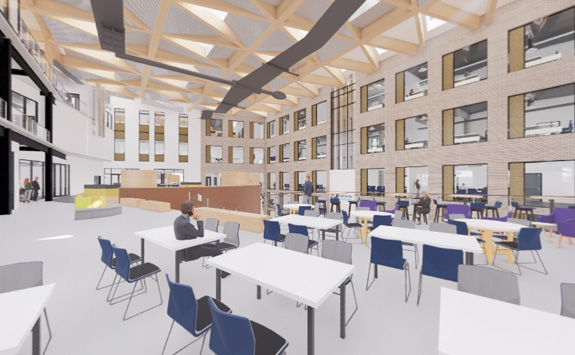
World-Class Design
Discover how our new £110m building will use sustainable design to create an open, inclusive, creative and entrepreneurial space for our engineering community.
Merging heritage with enterprise
The redeveloped Stephenson building will be the place for future engineers, researchers, designers, and visionaries to come together and tackle world challenges together.
Stephenson is the home for people who make things work.
An inventive team of architects, designers, engineers, and builders is transforming the current building. Built in the 1940s, it will become a state-of-the-art gateway to innovation and design.
Sustainable by design
We’re dedicated to making the world a better, greener place to live and work.
The sustainable design for the new Stephenson utilises many initiatives to reduce the carbon footprint of the project and the building’s life thereafter.
The design reduces embedded carbon in the building fabric through:
- use of a timber structure for the fourth floor
- reuse of half of the current building floor space
- highly efficient use of floorspace
Reducing in-use carbon
We're substantially reducing in-use carbon through:
- utilisation of the CHP (Combined Heat & Power) plant
- reduced heat loss using high air tightness levels
- minimised use of mechanical ventilation
We're promoting more sustainable behaviours of occupants through:
- sustainability research and education
- office and IT support for virtual meetings
- reducing future need for travel
Facilities for transformative research and innovation
Inspired by flexibility, collaborative working and digital infrastructure, the building’s research facilities will include:
- flexible research space to promote new interactions
- wet and dry labs and spaces located to promote synergies between hub activities
- permanent desk space for non-academic partners who wish to co-locate staff
- hot desks for staff from across the University and external staff on secondment
Inclusive education spaces
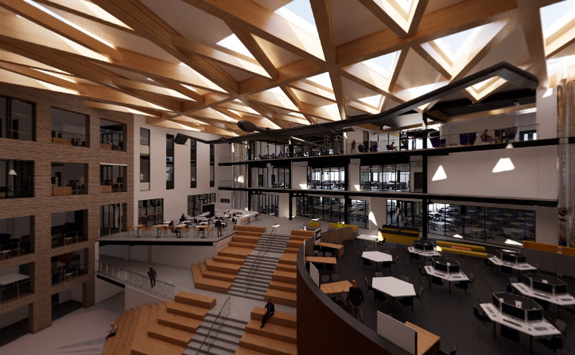
The education facilities will enhance student experience and support blended learning. They will include:
- Maker Space - a new student-centred zone for interdisciplinary collaboration, creativity and entrepreneurship
- multi-purpose teaching laboratories with flexibility to support multiple disciplines
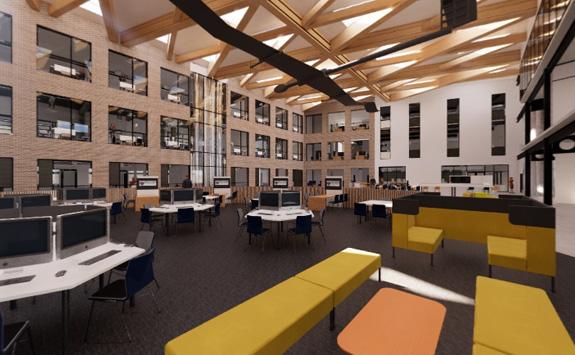
- digital learning spaces with large flat-floor areas for flexible working
- blended social learning spaces
- environments for quiet study and busy group work
- two lecture theatres, each with capacity for 180 people
Specialist labs and services
The building will be home to a wide range of specialist facilities, including:
- analytical facilities and services
- biomedical engineering facilities, including:
- tissue engineering laboratory
- assistive technology testing facilities
- neural engineering - electrochemical and mechanical testing of neural interfaces
- biomaterials lab
- bacterial wet lab
- human tissue lab
- materials, manufacturing, processing and testing facilities
- wind tunnel – renewable energy infrastructure, automotive, aviation, structures