Bowel cancer and patient outcomes
Transforming research into real-world benefits for patients.
Bowel cancer in the UK
Bowel cancer is the fourth most common cancer in the UK, after breast, prostate and lung, and the second most common cause of cancer deaths.
In the UK, there are approximately 48,000 new cases of bowel cancer each year. An estimated 54% of cases thought to be preventable. Every 30 minutes, a cancer patient dies from the disease. Early detection is critical. The earlier the cancer is found, the more treatable it’s likely to be.
As healthcare systems work to improve cancer outcomes, interest is growing in how artificial intelligence (AI) can support clinicians, improve diagnostic accuracy, and help identify more patients at the earliest possible stage of disease.
Harnessing the power of AI
We’re leading this work through the COLO DETECT study, led by Professor Colin Rees in our Faculty of Medical Sciences. The project shows how AI can transform early detection of bowel cancer and how strong partnerships can improve patient outcomes.
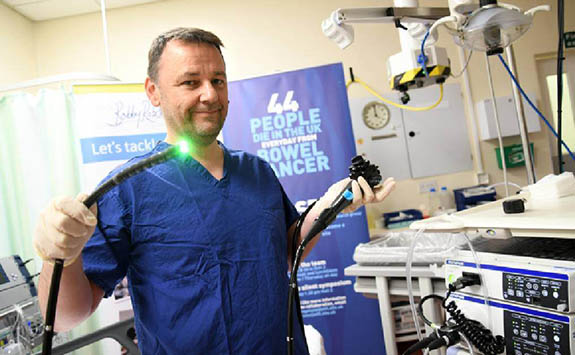
At the heart of the project is GI Genius™, an AI-powered tool that connects to standard colonoscopy equipment. It analyses live video during procedures and flags potential abnormalities with a visual marker to support clinicians in real time.
The technology acts as a ‘second pair of eyes.’ It identifies subtle or easily missed lesions called polyps, which may develop into cancer. It is especially effective at finding small or flat lesions that are usually overlooked.
The success of COLO‑DETECT is built on close collaborative between the University and the NHS. The study was delivered with South Tyneside and Sunderland NHS Foundation Trust, and a network of NHS organisations across England.
The trial involved 2,032 patients across 10 centres, making it one of the largest real-world studies of AI in colonoscopy. This multi-centre approach ensured strong clinical evidence and supported rapid translation into NHS practice. The study informed the National Institute for Healthcare and Clinical Excellence (NICE) review of AI technologies and led to NICE recommending use of GI genius in clinical care.
Technology partners also played a key role by embedding AI tools into existing clinical workflows without disrupting patient care.
Findings so far
The study found that using AI during colonoscopy significantly improves detection of precancerous polyps, delivering around a 30% increase compared to standard procedures.
It also enabled more patients to be identified at an earlier stage by detecting small and difficult to spot lesions that might otherwise be missed. This reduces the risk of cancer progression.
These improvements were achieved without compromising patient safety, showing that AI can enhance diagnosis and play a major role in the prevention of bowel cancer.
The long-term impact on patients is clear. It means earlier diagnosis, less invasive treatment and improved survival rates. With around 48,000 new bowel cancer cases diagnosed in the UK each year, AI-enabled diagnostics could reduce mortality rates and ease pressure on healthcare services.
The future of AI-enabled healthcare
Through research such as COLO DETECT, we’re helping shape a future where intelligent technologies work alongside healthcare professionals to deliver faster, more accurate, and more effective care.
The study offers a blueprint for how AI can be safely integrated into routine clinical practice. It combines world-leading research, NHS collaboration, and technological innovation to improve patient outcomes.
As AI continues to evolve, Newcastle University is ensuring these advances translate into real-world benefits; preventing cancer, helping more patients receive earlier diagnoses, improving survival rates, and transforming the future of healthcare.