Using hydrogen to achieve net zero
Research leading to a cleaner, greener future.
Unlocking hydrogen’s potential for a cleaner future
Hydrogen is set to play a major role in how we cut carbon emissions and move towards net zero.
Here at Newcastle University, we’re working with industry, government and academic partners to turn hydrogen from a promising idea into a practical part of everyday energy systems.
A global challenge
Climate change is creating urgent global challenges. To meet them, we need energy that is clean, reliable, and affordable.
In the near future, hydrogen is expected to play a major role in decarbonising transport, manufacturing, and energy storage. To meet global climate targets, we must produce hydrogen at scale with near‑zero emissions.
Our researchers are tackling the scientific and engineering barriers that stand in the way. Their work helps shape how hydrogen fits into the wider energy system, alongside electricity and other low‑carbon technologies.
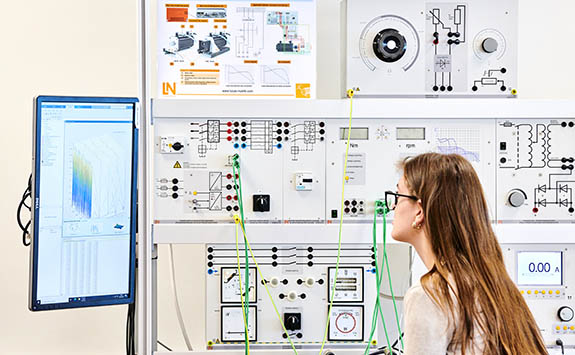
Our researchers are bringing together expertise in engineering, data science and advanced manufacturing to tackle some of the biggest barriers to large-scale hydrogen adoption.
Working together to design the future of energy
At the heart of this work is the Newcastle University Centre for Energy. This Centre unites experts across disciplines to rethink how energy systems should work, from local communities to national networks.
Its mission is to support the delivery of clean, affordable energy by advancing innovation in technology, infrastructure, behaviour, ethics and policy.
Another major initiative is the Hydrogen Integration for Accelerated Energy Transitions (HI-ACT) Hub. This £10 million national research hub, funded by the Engineering and Physical Sciences Research Council, brings together teams from 12 universities and more than 68 partners, including businesses, policymakers, regulators and community organisations.
HI-ACT explores where hydrogen adds greatest value, how it can work alongside electricity and other energy systems, and how to develop hydrogen infrastructure that is fair, efficient, and secure.
Building on strong collaboration with industry and regional stakeholders, we are also helping shape how local and national energy systems work together.
Turning research into practical solutions
Our partnerships with industry and regional organisations help us test ideas in real settings.
Global Hydrogen Production Technologies Centre (HyPT)
We’re part of the £14.1 million Global Hydrogen Production Technologies Centre (HyPT).
This international partnership is working to produce low-cost net zero hydrogen at a large scale. Professor Mohamed Mamlouk and colleagues are developing low-temperature electrolysers, a key technology for producing low-emissions hydrogen. Their work aims to improve performance and lower costs using materials that are widely available.
Ocean-REFuel
Professor Mamlouk also leads Newcastle’s work on the £10m Ocean-REFuel programme. It explores how offshore wind and marine energy is used to produce zero-carbon hydrogen and ammonia fuels.
Project VOLT
Project VOLT (Vector-Optimised Microgrid Operations for Industrial Low-carbon Transition) works with organisations including the Port of Tyne, Newcastle Airport, Severfield and Pulsant. The project explores multi-fuel microgrids. These are flexible energy systems that can draw power from many sources at the same time.
Using simulations, it tests how energy demand, infrastructure limits, and planning decisions affect cost and network flexibility. Its goal is to show how hybrid energy systems can keep critical sites running while improving resilience and efficiency.
Project D-Suite
Project D-Suite is a partnership with UK Power Networks and Integrated Powertech.
So far, the project has received more than £8 million to explore how power electronics can increase capacity on low-voltage networks by 20% to 40%. Power electronics are devices that control and move electricity.
This work supports the growth of low-carbon technologies, while reducing the need for expensive infrastructure upgrades.
Converting dirty water into clean hydrogen
We’re working with partners across Europe to develop technologies that use renewable energy to produce hydrogen from low-quality water.
Newcastle is also leading the development of advanced membrane materials that improve performance and last longer. This work will help make clean hydrogen more affordable. It will also strengthen the UK’s energy security and reduce reliance on rare raw materials.
Building the skills for a net zero future
Reaching net zero isn’t only about technology. It also requires people with the right skills.
Through Renewable Energy North East Universities Plus (ReNU+), a partnership between Newcastle, Durham, and Northumbria Universities, we’re training the next generation of clean‑energy specialists.
The programme combines interdisciplinary doctoral training and close industry collaboration to prepare graduates for careers in the low-carbon economy.