
Meet Vinita
Fine Art BA
Exposure to new perspectives
Coming from India and studying Fine Art in the UK meant being exposed to completely different perspectives, teaching methods, artistic conversations, and opportunities that I may not have experienced otherwise.
I was drawn to how interdisciplinary and open Fine Art education felt in the UK. There’s a strong emphasis on experimentation, critical thinking, and developing your own voice as an artist, which really appealed to me when I was applying.
At the same time, studying abroad allowed me to meet people from very different backgrounds and cultures, which has influenced both my practice and the way I see the world.
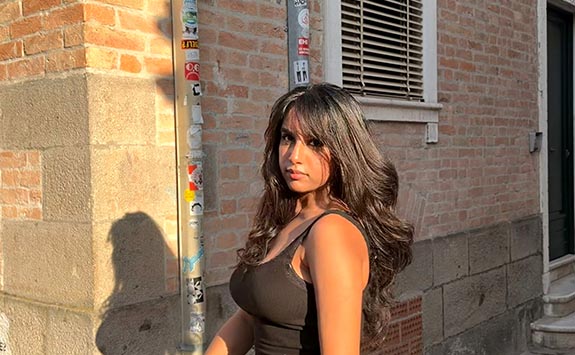
Newcastle feels like home
I wanted a city that still felt vibrant and creative, but also comfortable and manageable to settle into. Newcastle felt like the perfect balance. The more I researched the university, the Fine Art department, and the city itself, the more certain I became. And now, looking back, I genuinely can’t imagine myself anywhere else. Newcastle has shaped me creatively and personally in ways I never expected, and it really feels like home to me now.
Unexpected friendships
Through Fine Art especially, I’ve met some of my closest friends, and a lot of those friendships happened very unexpectedly, through exhibitions, workshops, societies, or even random conversations in the studio.
I love going to exhibitions, galleries, cafés, and vintage markets, especially with friends. I’m also really interested in fashion and creative direction, so I enjoy being involved in shoots, styling, and society events alongside Fine Art.
Newcastle as a city makes socialising easier because people here are genuinely friendly and approachable.
Growing socially, creatively and professionally
Last year, I joined the Hindu and Sikh Society, and this year I’ve been involved with the Fashion Society. In both societies, I was part of the committee, so alongside attending events, I was also involved in more of the organisational and administrative side of things.
I think being involved in societies has helped me grow socially, creatively, and professionally alongside my degree.
Challenging - in a good way
I think one of the strongest things about the course is that it really encourages you to develop your own voice and direction as an artist rather than trying to fit everyone into the same structure.
The course is quite interdisciplinary, so you’re not limited to one medium. You can explore painting, sculpture, installation, photography, film, performance, printmaking, textiles, or combine multiple practices together depending on what interests you creatively. There’s a lot of freedom to experiment, which can feel overwhelming at first, but eventually becomes one of the most rewarding parts of the degree.
Studying Fine Art at Newcastle University has been a very open, experimental, and self-driven experience.
At the same time, it’s not just about making artwork. The course also pushes you to think critically, research deeply, and understand the context behind your work and contemporary art more broadly. Tutorials, critiques, exhibitions, and conversations with tutors and other students become a huge part of the learning process.
I’d describe the degree as challenging in a good way, it really pushes you creatively and personally, but it also gives you the space to discover what kind of artist and creative thinker you want to become.
What stands out for you about your degree?
The course allows you to explore your own ideas and develop independently as an artist, but at the same time, there’s always guidance available when you need it.
The facilities and workshop access are a huge advantage. Being able to experiment across different mediums, whether that’s printmaking, sculpture, installation, textiles, or digital work, really encourages you to push your practice further and not limit yourself creatively.
Another thing that stands out is the studio culture. A lot of learning happens through conversations with other students, tutorials, crits, and simply being around people making completely different kinds of work. It creates a very collaborative and inspiring environment.
I also really value how many opportunities the department encourages students to apply for outside of university, such as exhibitions, ambassador roles, workshops, internships, fellowships, and live projects.
Application tips
One of my biggest tips would be to include work that shows how your ideas developed. Don’t just include finished outcomes. Include sketches, failed attempts, unfinished experiments, research, material testing, and the stages that helped your final ideas emerge. I think tutors are often more interested in your creative process, curiosity, and willingness to explore than in presenting everything as “perfect.”
Studying Fine Art has made me realise that while I love creating art, I’m also deeply interested in understanding and working with art in a wider sense.
Art reflects society
I genuinely believe Fine Art is one of the most important fields people can pursue, especially in today’s world. Art reflects society. It captures emotions, histories, identities, politics, culture, and the realities people live through. In many ways, art helps us understand both the best and the worst parts of humanity.
I think students should pick this degree if they are curious, creative, and open to exploring ideas beyond fixed answers. Fine Art is not just about learning how to make work. It teaches you how to think critically, communicate visually, research deeply, and develop your own perspective on the world.
It’s also a degree that constantly pushes you outside your comfort zone. You learn independence, adaptability, problem-solving, and confidence in your own ideas. For me, Fine Art feels less like just a degree and more like a way of understanding and responding to the world around you.
Related student stories


Lauren from United Kingdom
Advanced Computer Science MSc
The course has given me the opportunity to build on what I learnt during my undergraduate degree and explore areas of computing in much more depth.

Aung from Myanmar
Transport Engineering, Planning and Management MSc
My first time coming to Newcastle was after a trip to London. The city is beautiful with amazing bridges going over the Tyne river.

John from India
Geospatial Surveying and Mapping BEng
My course focuses on land and marine surveying applications. What sets the University apart in this area are the dedicated labs.

Aaryan from India
Computer Science BSc
To support my studies, I’ve been awarded a VCIS (Vice Chancellor International Scholarship) worth £4,000. The rest of my fees are self-funded.

Lukman from Nigeria
Mechanical and Systems Engineering PhD
Newcastle University really welcomes international students. It’s clear that the institution strongly values inclusion and diversity.
Madiha from India
English Literature with Creative Writing BA
The application process was straightforward and I felt very supported by the University throughout.


Jasmine from Malaysia
Dietetics MDiet
Newcastle feels like somewhere between a big city and a small town.

Hana from Czechia
International Business Management BSc
I’m not sure what I want to do in the future, being able to study lots of different modules is giving me the chance to explore all the possibilities.

Bernardo from Brazil
Law PhD
I am deeply passionate about the RED (Researcher Education and Development) programme - it has been an integral part of my PhD journey.