Artificial Intelligence BSc Honours
2027 entry information
- Study mode and duration
- Full time: 3 years
- UCAS code
- G407
- UCAS institution name and code
- NEWC / N21
- Tuition fees (Year 1)
-
FT Home: £10,050
FT International: £31,500 Scholarships available - Typical entry requirements
-
A-Level: AAB
IB: 34 points
View alternative offers - Course delivery
- On Campus
- Work placement opportunity Study abroad option

Course overview
It’s reshaping tech and transport, finance and farming. It can analyse medical tests and put together playlists on Spotify. AI is impacting almost everything we do, and on our Artificial Intelligence course, you’ll learn how to develop and train the technology in creative ways. You’ll leave your degree at Newcastle primed to lead in this new, disruptive area.
What AI can do – and what people want from it – changes rapidly. Our curriculum responds to these shifts, giving you a robust, adaptable skillset, based on what’s happening across industry, research and regulation. It’s informed by our connections with some of the biggest companies in AI, like NVIDIA, Microsoft and Amazon.
Several subjects underpin the understanding and development of AI. That's why our course isn't confined to the School of Computing. Instead, our computing, mathematics, statistics and engineering staff deliver bespoke, AI-focussed modules. This way, when you leave Newcastle, you’ll be able to flex what you’ve learned to fit a future that is currently impossible to imagine.
“Many universities have strong individual departments. Newcastle's strength is bringing different disciplines together around shared challenges, which is exactly what AI requires.”
– Professor Murray Pollock, Academic Director for Data and Digital Technologies
We’re home to the National Innovation Centre for Data (NICD)
We’re proud to be the only UK university to host a national innovation centre for data, particularly because of the advantage it gives our students. NICD delivers modules across the Artificial Intelligence curriculum, so from day one you’ll work with real-world data, tackling the sorts of challenges that matter right now (and preparing you for what you might see in the future).
“No other UK university hosts a national centre focussed on enabling companies and students to innovate using AI and Data Science. It is an integral part of the programmes - not an optional placement or a practical project added after the technical curriculum has been delivered. As a result, students will graduate with the practical experience needed to stand out."
- Barry Hodgson, Director of Strategy, NICD
Why study at Newcastle?
- Delivered in partnership with the National Innovation Centre for Data: Work with real data and gain professional skills, from the first semester to your final year
- Benefit from our diverse network of AI researchers and industry professionals: This course goes beyond computing. You'll learn from experts across the range of AI fields at the university
- Modules based on our varied and exciting research: Specifically designed to equip you with skills for your career in AI
- We talk about ethics, safety, and sustainability throughout: These conversations shouldn’t be confined to one module, so we continue to have them across your degree

Working with a real organisation, managing deadlines, and delivering something that will actually be used has pushed me far beyond what a classroom setting could offer
Quality and ranking
Professional accreditation and recognition
Professional accreditations are reviewed regularly by professional bodies to ensure they meet the latest industry practices and regulatory standards. This keeps your degree rigorous, relevant, and highly valued by employers, providing a clear pathway into your chosen career.
If you are studying an accredited degree and considering a career in Europe after graduation, it is important to stay informed about international standards. The best resource for current information is the UK Government's guidance on recognition of UK professional qualifications in EU member states.
This official resource provides essential details on:
- whether your profession is regulated in another country.
- the specific steps you need to take to practice abroad.
- which organisations you should contact to begin the process.
Our students


Aaryan from India
Computer Science BSc
To support my studies, I’ve been awarded a VCIS (Vice Chancellor International Scholarship) worth £4,000. The rest of my fees are self-funded.


Lucia from Peru
Computer Science BSc
I chose Newcastle University because of its high academic standards and strong research opportunities.


Muhammad from Malaysia
BSc Computer Science
I chose to study here in Newcastle because I love the inspiring architecture of the University and living here in general.


Luke from United Kingdom
Computer Science BSc
I think putting yourself in new environments like this is how you grow and develop as a person.


Stella from Myanmar
Computer Science BSc
My favourite thing about my course is the hands-on projects, which allow me to apply what I’ve learned and build real-world skills.
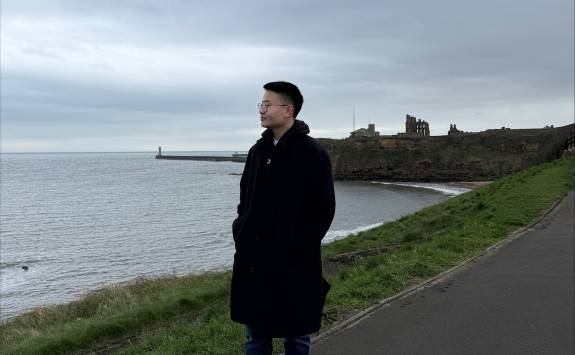

Drilden from Indonesia
Computer Science (Cyber Security) BSc
Having a course that directly matched my interests made Newcastle stand out as the right choice for me.
What you'll learn
You’ll learn about programming, software development, mathematics, statistics and data. You’ll study topics like machine learning, generative AI, language technology and intelligent decision-making systems, as well as how we can develop responsible and trustworthy AI systems.
You’ll work with NICD and the National Edge AI Hub, so you can contextualise how you’ll use your skills in a professional setting.
Modules
The information below is intended to provide an example of what you will study.
Most degrees are divided into stages. Each stage lasts for one academic year, and you'll complete modules totalling 120 credits by the end of each stage.
Full details of the modules on offer will be published through the Programme Regulations and Specifications ahead of each academic year. This usually happens in May.
Our teaching is informed by research. Course content may change periodically to reflect developments in the discipline, the requirements of external bodies and partners, and student feedback.
During Stage 1, you’ll study contemporary topics in Data Science and AI and discover what interests you in the current discourse, from social and ethical issues to cybersecurity. You’ll code with Python and R, and get to grips with the Maths and Statistics you need to succeed in the future. Throughout, you’ll get experience of real-world datasets and ongoing research.
All candidates will take the following compulsory modules:
When you reach Stage 2, you’ll study the core AI techniques used in modern systems in more depth, so you understand how they work and how to deploy them in real-world scenarios. This includes Deep Learning, Generative AI and Natural Language Processing. At the end of Stage 2, you’ll work with NICD on real-deployment of AI.
All candidates will take the following compulsory modules:
At Stage 3, you’ll develop advanced specialist knowledge. You’ll use independent judgement as you address complex and open-ended problems. You’ll study areas including:
- computer vision
- cyber-physical AI
- reinforcement learning and
- autonomous systems.
You will critically engage with up-to-date developments in areas relevant to data and AI, like ethics, law, society and the environment.
At the end of Stage 3, you’ll work on a substantial project which can take a number of forms: working on a problem in industry or conducting cutting-edge research. This is your opportunity to integrate your learning: you’ll select and evaluate appropriate methods, manage a complex investigation, and communicate evidence-based conclusions to specialist and non-specialist audiences.
All candidates will take the following compulsory modules:
| Compulsory Modules | Credits |
|---|---|
| Responsible and Trustworthy Data and AI | 20 |
| Vision and Cyber-Physical AI | 20 |
| Reinforcement Learning and Autonomous Systems | 20 |
| Contemporary Topics in Data Science an AI | 20 |
All candidates will choose one module from the following list:
| Modules | Credits |
|---|---|
| Individual Project in Data Science and AI | 40 |
| Case Study Project in Data Science and AI | 40 |
We base these figures and graphs on the most up-to-date information available to us. They are based on the modules chosen by our students in 2025-26.
Teaching time is made up of:
- scheduled learning and teaching activities. These are timetabled activities with a member of staff present.
- structured guided learning. These are activities developed by staff to support engagement with module learning. Students or groups of students undertake these activities without direct staff participation or supervision
How you'll learn
Teaching methods
You’ll learn through a combination of different methods including:
- lectures
- group work
- hands-on labs and practicals
- contemporary case studies
- modern AI systems
- applied computational workflows.
An immersive final year project
Your final project is your opportunity to work on a specific area of Artificial Intelligence. Your project will be either research-informed, industrially motivated or entrepreneurship-focused, and could hone in on:
- deep learning
- generative AI
- natural language processing
- reinforcement learning
- perception systems
- autonomous systems, or
- intelligent decision-making technologies.
It’s an in-depth, self-directed learning experience, and you’ll show you can evaluate arguments, make judgements and solve complex problems.
When you’ve completed your third year project, you’ll have evidence of your:
- technical capability
- project management skills
- teamwork
- independent judgement, and
- communication skills.
You’ll be able to build this evidence into portfolios, applications and interviews as you start your career.
Assessment methods
You'll be assessed through a combination of:
-

Assignments – written or fieldwork
-

Case studies
-

Coursework
-
Dissertation or research project
-

Examinations – practical or online
-

Group work
-

Interviews
-

Portfolio submission
-

Practical sessions
-

Presentations
-
Projects
-

Reflective report/journal
-

Reports
Skills and experience
We want you to graduate ready for a career that excites you. The Artificial Intelligence BSc is designed to give you the skills, attributes and experiences you need for a future in the AI industry.
Skills you’ll develop on the course
Professional skills
To excel in a career in AI, you’ll need a professional outlook. We’ll teach you:
- how to work successfully both independently, and as part of a multidisciplinary team
- communication skills, with peers and people who aren’t AI experts
- project planning and project management – balancing risks and resources and meeting deadlines
- adaptability
- time management.
Research skills
You’ll become adept at research, using your skills to:
- read, understand and evaluate the latest developments in AI
- design clear research questions in response to complex problems
- evaluate the results and limitations of investigations you’ve designed
- choose the right statistical, computational and AI approaches – and explain why
- undertake independent inquiry
- develop novel solutions to challenging real-world problems
- work beyond the taught material.
Practical skills
You’ll develop a host of relevant practical skills, including the ability to:
- develop reliable code in Python and R
- use the latest AI toolkits, and understand which to use and when
- build and evaluate statistical, machine learning and AI models
- design, implement and assess data-driven and AI systems in real scenarios
- use your analytical and computational skills in open-ended and evolving contexts
- create effective visualisations, reports and presentations
- explore new data to make best use of it.
Read more about the skills and attributes you can expect to build at Newcastle.
Support
We take your health and wellbeing seriously and are committed to supporting you throughout your studies so you can fulfil your potential at university. This support includes:
- an adviser who is an academic member of staff who can help you with academic and personal issues throughout your degree
- a peer mentor scheme which pairs you with a current student from your course to help you navigate your first year at university
- a staff-student committee, to give you an opportunity to have a say in how your degree works
- a dedicated School Wellbeing Adviser who can offer comprehensive listening and support and signpost you to other University support services or external support agencies
- dedicated wellbeing facilities and regular activities
Opportunities
Study abroad
Experience life in another country by choosing to study abroad as part of your degree. You’ll be encouraged to embrace fun and challenging experiences, make connections with new communities and graduate as a globally aware professional, ready for your future.
You can choose to spend up to a year studying at a partner institution overseas.
If you choose to study abroad, it will extend your degree by a year.
Find out more about study abroad
Work placement
Apply your practical skills, increase your confidence and gain real-life work experience to accelerate your career. Take a 9-12-month industrial placement in the UK or abroad. Work placements usually take place in stage 3 of your studies and extend your degree by one year.
You may be interested in
Entry requirements
All candidates are considered on an individual basis and we accept a broad range of qualifications.
The entrance requirements and offers below apply to 2027 entry.
| A-Level | |
|---|---|
| International Baccalaureate | |
|---|---|
Other UK and the Republic of Ireland qualifications
Alternative offers at Newcastle
Through one of our contextual or alternative offer routes, you could receive an offer of up to three grades lower than the typical requirements.
Contextual offers
We use certain contextual data from your UCAS form, alongside your application, to consider challenges that you may have faced in your education and the potential effect this may have had on your qualifications. This means you may be eligible to receive a lower contextual offer.
PARTNERS offers
One of the largest and longest support entry routes to university of its kind for students from underrepresented backgrounds. We support applicants from application through to study.
Realising Opportunities offers
A unique programme delivered in collaboration with 10 leading, research-intensive universities in the UK. The programme is open to students in Year 12/first year of college.
Pathways to Newcastle offers
Pathways to Newcastle, our national skills entry route, is available for specific subject areas.
High Performance Athletes
We support promising athletes at the application stage, who compete in regional, national or international levels in their sport.
Qualifications from outside the UK
English Language requirements
International Pathway and English Language courses
International Pathway courses are specialist programmes designed for international students who want to study in the UK. We provide a range of study options for international students in partnership with INTO.
These courses are specifically designed for international students who want to study in the UK and progress onto one of our undergraduate degrees. Our International Study Centre, has a range of study options including:
- International Foundation
- International Year One
- English Language courses
Find out more about International Pathway courses
Admissions policy
This policy applies to all undergraduate and postgraduate admissions at Newcastle University. It is intended to provide information about our admissions policies and procedures to applicants and potential applicants, to their advisors and family members, and to staff of the University.
University Admissions Policy and related policies and procedures
Credit transfer and Recognition of Prior Learning
Recognition of Prior Learning (RPL) can allow you to convert existing relevant university-level knowledge, skills and experience into credits towards a qualification. Find out more about the RPL policy which may apply to this course.
Your future
When you graduate with a degree in Artificial Intelligence from Newcastle University, you’ll be able to take career routes across almost any industry. Technology, of course, but also healthcare, hospitality, entertainment, government – they’re all clamouring to incorporate AI into their processes. You might work as a:
- data scientist
- AI engineer
- machine learning engineer
- data analyst
- analytics consultant
- software developer
- business intelligence analyst
If you find that research is your calling, the course will prepare you for further study in more specialist areas of AI, such as natural language processing, agentic AI, generative AI, robotics, security, deep learning optimisation, computer vision, and lots more.
Careers support
We want all our students to succeed in their careers. That’s why we’ve designed our courses to give you the skills employers are looking for. You can also go to guest lectures from industry professionals, mock interviews, and professional skills workshops.
Every year, the school hosts a week of career events. In the past, these have included:
- hackathon workshops
- placement discussions
- coding and enterprise challenges
- employer talks
- networking events
Our Careers Service is one of the largest and best in the country, and we have strong links with employers. We provide an extensive range of opportunities to all students through our ncl+ initiative.
Facilities and environment
Facilities
One of the perks of doing an AI degree is getting to play with new, exciting tech. We keep up to date with the latest and greatest hardware, so when you come to Newcastle you’ll have access to:
- the latest generation of Graphical Processing Units (GPUs), Tensor Processing Units (TPUs) and Intelligence Processing Units (IPUs)
- Edge AI devices such as the Jetson Nano
- AI robotic dogs, humanoid robots and bespoke devices.
You’ll learn in different buildings around our city centre campus. The main two are the Urban Sciences Building (USB) and Herschel Building. Click to find out more:
The USB is a ‘living laboratory’ – fitted with 4000 sensors that record detailed data about how the building is used. Anyone can use the data; you can use it in projects, if you like. We also have up-to-date data visualisation technology, which you can weave into final-year projects, too.
The USB is part of our flagship Newcastle Helix development, which is home to NICD and the National Edge AI Hub.
Our region is an AI Growth Zone
The North East has a thriving tech sector, and in 2025, the government named it an AI Growth Zone, guaranteeing significant investment in developing AI in the region. By studying Artificial Intelligence at Newcastle, you’ll access the benefits that the Growth Zone brings to people with your expertise. A vibrant research culture and a host of graduate jobs in AI engineering and safety, all on your doorstep.
At Newcastle University, we also lead National Edge AI Hub, a collaborative group of 15 universities and 75 industrial partners at the forefront of researching and working with AI and Edge Computing. National Edge AI Hub members teach on the third year of the course, too.
Tuition fees and scholarships
Tuition fees for academic year 2027-2028
| Qualification: BSc Honours | |
|---|---|
|
Home students full time 3 years |
Tuition fees (Year 1)
£10,050 |
|
International students full time 3 years |
Tuition fees (Year 1)
31,500 |
Year abroad and additional costs
For programmes where you can spend a year on a work placement or studying abroad, you will receive a significant fee reduction for that year.
Some of our degrees involve additional costs which are not covered by your tuition fees.
Scholarships
Find out more about:
How to apply
Apply through UCAS
To apply for undergraduate study at Newcastle University, you must use the online application system managed by the Universities and Colleges Admissions Service (UCAS). All UK schools and colleges, and a small number of EU and international establishments, are registered with UCAS. You will need:
- the UCAS name and institution codes for Newcastle University (NEWC/N21)
- the UCAS code for the course you want to apply for
- the UCAS 'buzzword' for your school or college
If you are applying independently, or are applying from a school or college which is not registered to manage applications, you will still use the Apply system. You will not need a buzzword.
Apply through UCASInternational students can apply through an agent
International students often apply to us through an agent. Have a look at our recommended agents and get in touch with them.
Open days and events
UK open days
You'll have a number of opportunities to meet us throughout the year at our on-campus and virtual open days.
You'll be able to:
- explore our beautiful campus
- find out about our vibrant city
- discover what students think about studying at Newcastle
You'll also have the opportunity to speak to academic staff and find out more about the subjects you're interested in.
Find out about how you can visit Newcastle in person and virtually.
Worldwide events
We regularly travel overseas to meet with students interested in studying at Newcastle University. Visit our events calendar to find out when we're visiting your region.
Online events
Get in touch
By phone
Call us on +44 (0) 191 208 3333 and press option 1. Our opening hours are Monday to Friday 10am until 4pm.
Online
Keep updated
We regularly send email updates and extra information about the University.
Receive regular updates by email