
Meet Simin
Sociolinguistics: Identity and Belonging among Chinese Migrants in the UK, PhD
Meeting people from different backgrounds
I was curious about what it would be like to live in a completely different environment. Moving abroad meant stepping out of my comfort zone, but that was exactly what I was looking for. I wanted to meet people from different backgrounds and see how ideas are discussed in a more international setting - especially because I'm studying Language and Intercultural Communication.

Choosing Newcastle was a personal decision
It was a very personal decision. I had already spent time in the UK during my master's in Edinburgh, and I really value being in the North because it felt familiar, comfortable and somewhere I could see myself settling for a few more years. At the same time what really confirmed my decision was the people. Before applying for a PhD I reached out to my current supervisor, and her research aligned very closely with what I wanted to do. She was incredibly supportive and open to my ideas from the very beginning. That gave me a strong sense that this would be the right environment for my PhD.
Friendly and supportive university
What I really appreciate about Newcastle is how friendly and supportive it feels. Whether it’s lecturers, supervisors, or other students, people are approachable and willing to help, which makes a big difference during a PhD.
The city itself has a great balance. It’s lively and full of character, but still easy to navigate and not overwhelming. Overall, it’s a place where you can focus on your work, but also enjoy everyday life, which I think is really important.
Careers guidance
I’ve attended several sessions run by the university’s careers service specifically for PhD students, which I’ve found really helpful. As a PhD student in Social Sciences there are moments where I can feel unsure of myself, especially when our work is quite independent. These sessions really helped me put things into perspective and, in a way, eased that sense of imposter syndrome.
About my degree
My degree explores how language, identity, and migration are connected, focusing on the lived experiences of Chinese 1.5-generation migrants in the UK. I work with people’s personal stories to understand how they navigate different languages, cultures, and senses of belonging across different stages of their lives.
If you’re considering a similar path, it’s a degree that really encourages you to think deeply about people’s experiences and to question assumptions about language and identity. It’s also quite independent, so you need to be comfortable shaping your own project, but at the same time, you’re supported by a research community that helps you develop your ideas. Overall, it’s challenging but very rewarding, especially if you’re interested in real-world issues around migration, multilingualism, and culture.
What stands out about my degree
What really stands out to me about my degree at Newcastle is the balance between independence and support. As a PhD student, you’re given the space to shape your own research and develop your own ideas, but at the same time, you’re never left to figure things out on your own.
My supervisors have been incredibly supportive and open to discussion, which makes a big difference when you’re working on a long-term project. There’s also a sense of community within the school, including series seminars, training sessions, or just informal conversations with other PhD students.
Through my research, I get to listen to and engage with participants’ lived experiences, and think carefully about how language, identity, and migration are connected in their everyday lives.
What does the future hold?
I hope to continue working in academia, ideally in a role that combines research and teaching. I'm also open to roles beyond academia that are connected to language and migration.
Alongside my research, I've been working as a teaching assistant across different modules, which has allowed me to develop my confidence in the classroom. Also, the training sessions and support available for PhD students have helped me think more broadly about my development and career direction.
The degree is also very flexible and allows you to shape your own research around topics you genuinely care about. At the same time, you’re supported by experienced supervisors and a strong academic community, so you can develop your ideas with confidence.
Related student stories


David from United Kingdom
Architecture and Urban Planning BA
Architecture and Urban Planning is perfect for students who are interested in either design or the built environment but don't know where to start.


Aung from Myanmar
Transport Engineering, Planning and Management MSc
My first time coming to Newcastle was after a trip to London. The city is beautiful with amazing bridges going over the Tyne river.


John from India
Geospatial Surveying and Mapping BEng
My course focuses on land and marine surveying applications. What sets the University apart in this area are the dedicated labs.

Aaryan from India
Computer Science BSc
To support my studies, I’ve been awarded a VCIS (Vice Chancellor International Scholarship) worth £4,000. The rest of my fees are self-funded.


Lukman from Nigeria
Mechanical and Systems Engineering PhD
Newcastle University really welcomes international students. It’s clear that the institution strongly values inclusion and diversity.
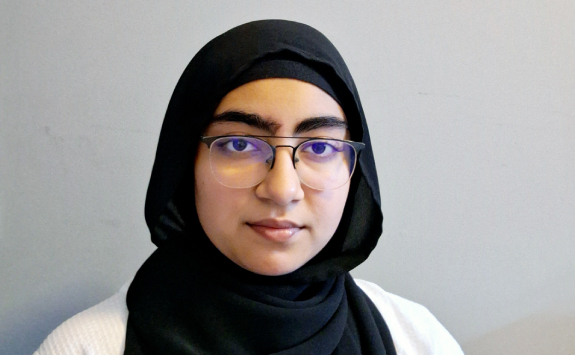
Madiha from India
English Literature with Creative Writing BA
The application process was straightforward and I felt very supported by the University throughout.


Jasmine from Malaysia
Dietetics MDiet
Newcastle feels like somewhere between a big city and a small town.
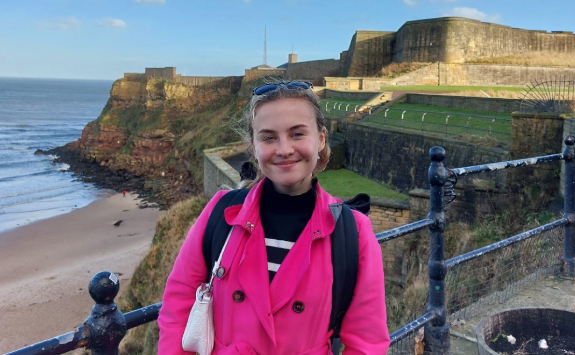

Hana from Czechia
International Business Management BSc
I’m not sure what I want to do in the future, being able to study lots of different modules is giving me the chance to explore all the possibilities.
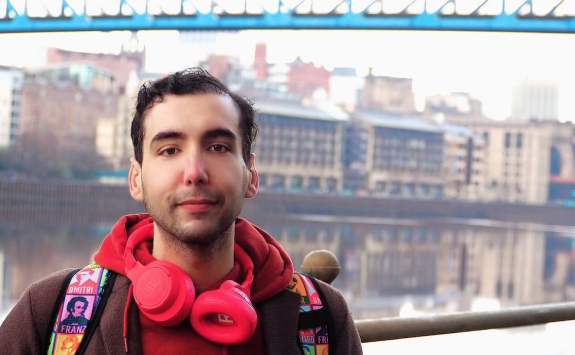

Bernardo from Brazil
Law PhD
I am deeply passionate about the RED (Researcher Education and Development) programme - it has been an integral part of my PhD journey.