Sustainability Management MSc
- Study mode and duration
- Course code
- 5499F
- Fees (per year)
- Typical entry requirements
-
View full entry requirements - Course delivery
- On Campus
Course information for entry year:
Overview
There is growing demand for managers who can lead and drive sustainability change across organisations and sectors.
This MSc helps you understand how organisations can respond to social, environmental and ethical challenges.
You will examine sustainability through core areas of management, including:
- political economy
- public policy
- entrepreneurship
- marketing
- finance
- accounting
- supply chains
You will learn how these functions shape organisational decisions and sustainability outcomes.
The course encourages you to think critically about the role of business in society. You will explore how organisations can move from traditional business models towards responsible and sustainable ways of working.
You will build the skills to:
- analyse complex problems
- work with stakeholders
- develop evidence-based responses
You will also complete an Advanced Sustainability Management Project, allowing you to apply your learning to a real-world sustainability issue.
Important information
We've highlighted important information about your course. Please take note of any deadlines.
Please rest assured we make all reasonable efforts to provide you with the programmes, services and facilities described. However, it may be necessary to make changes due to significant disruption, for example in response to Covid-19.
View our Academic experience page, which gives information about your Newcastle University study experience for the academic year 2025-26.
See our terms and conditions and student complaints information, which gives details of circumstances that may lead to changes to programmes, modules or University services.
Quality and ranking
Professional accreditations are reviewed regularly by professional bodies to ensure they meet the latest industry practices and regulatory standards. This keeps your degree rigorous, relevant, and highly valued by employers, providing a clear pathway into your chosen career.
If you are studying an accredited degree and considering a career in Europe after graduation, it is important to stay informed about international standards. The best resource for current information is the UK Government's guidance on recognition of UK professional qualifications in EU member states.
This official resource provides essential details on:
- whether your profession is regulated in another country.
- the specific steps you need to take to practice abroad.
- which organisations you should contact to begin the process.
Our students


Akash from India
Business Analytics MSc
I had heard people say postgraduate teaching in the UK is extensively driven by research.

Adwyait from India
Business Analytics MSc
The supportive environment, state-of-the-art facilities, and vibrant campus make it the ideal place for personal and academic growth.

Navonil from India
Business Administration MBA
The diverse and inclusive environment has made it easy to connect with people from different cultures and backgrounds.

Rahul Joseph from India
MSc Digital Marketing
Newcastle University was my clear choice due to its high global ranking and consistently excellent quality.

Siya from India
International Business MSc
I knew Newcastle would expose me to new business environments and career opportunities, strengthening my network and preparing me for a global career.

Shubham from India
International Marketing MSc
I enjoy the interactive lectures, group projects, and networking events that all show how the theory applies outside the classroom.

Arpita from India
Operations, Logistics and Supply Chain Management MSc
The diverse and collaborative environment encourages teamwork and fresh perspectives, making the learning experience engaging and enriching.


Zhuofan from China
MSc Digital Marketing
The atmosphere in Newcastle is very harmonious. I like living in a place full of human warmth.


Abisoye Fadare from Nigeria
Master of Business Administration (MBA)
I learn best by doing, and this MBA programme is built around that approach.
What you'll learn
You will develop a critical understanding of global sustainability challenges and their implications for organisations, markets and policy.
You will explore how to embed sustainability across organisational functions, including:
- strategy
- marketing
- finance
- accounting
- supply chains
You will apply systems, ethical and strategic thinking to complex sustainability problems. This will help you assess trade-offs and develop responsible responses.
Applied learning and an independent sustainability project will help you build your research, communication and teamwork skills.
Modules
The module information on our course pages is intended to provide an example of what you will study.
Our teaching is informed by research. Course content changes periodically to reflect developments in the discipline, the requirements of external bodies and partners, and student feedback.
Full details of the modules on offer will be published through the Programme Regulations and Specifications ahead of each academic year. This usually happens in May.
Some courses have optional modules. Student demand for optional modules may affect availability.
How you'll learn
You will be taught through a mix of interactive and applied learning methods, including:
- lectures
- seminars
- workshops
- case-based learning
- small group work
- project work
- guided independent study
Depending on your modules, you'll be assessed through a combination of:
- Case study
- Essay
- Oral presentation
- Problem-solving exercises
- Report
- Written exercise
During Stage Three, you will be able to pursue your own learning interests through a simulated consultancy project, delivered as part of a capstone module.
Acting as a consultant, you will:
- analyse a sustainability-related problem
- develop evidence-based insights
- provide actionable recommendations for a client organisation
This project will help you strengthen your skills in:
- independent research
- problem-solving
- professional reporting
- communication
Throughout your studies, you’ll have access to support from:
- academic staff
- academic advisers and research supervisors
- our University Student Services Team
- student representatives
- peers
You'll also be assigned an academic member of staff, who will be your academic adviser throughout your time with us. They can help with academic and personal issues.
Your teaching and learning is also supported by Canvas. Canvas is a Virtual Learning Environment. You'll use Canvas to submit your assignments and access your:
- module handbooks
- course materials
- groups
- course announcements and notifications
- written feedback
Your development
Professional skills
You will develop your ability to:
- analyse organisational sustainability challenges
- propose responsible solutions across business functions
- communicate challenges and solutions to different stakeholders
You will also strengthen your teamwork, leadership and cross-cultural collaboration skills.
Research skills
You will engage with evidence, theory and real-world sustainability problems. You will learn how to:
- frame sustainability questions
- evaluate sources
- apply critical analysis
- reflect on ethical implications
You'll develop these skills further through your Advanced Sustainability Management Project.
Practical skills
You will:
- apply sustainability concepts to organisational, policy and stakeholder contexts
- practise problem-solving, project planning and stakeholder engagement
- learn how to embed sustainability across organisational functions
- develop practical judgement to assess trade-offs and support more responsible decision-making
Entry requirements
The entrance requirements below apply to 2027 entry.
Our entry requirements and other information will be finalised in September 2026.
Qualifications from outside the UK
English Language requirements
Admissions policy
This policy applies to all undergraduate and postgraduate admissions at Newcastle University. It is intended to provide information about our admissions policies and procedures to applicants and potential applicants, to their advisors and family members, and to staff of the University.
University Admissions Policy and related policies and procedures
Credit transfer and Recognition of Prior Learning
Recognition of Prior Learning (RPL) can allow you to convert existing relevant university-level knowledge, skills and experience into credits towards a qualification. Find out more about the RPL policy which may apply to this course
Pre-Master’s and English Language courses
Need an alternative route to study this course? Our International Study Centre offers Pre-Master’s degrees and English language courses to prepare you for study.
Your future
Further study
This MSc provides a strong foundation for further study in sustainability management and related fields. You may choose to progress to a research degree, such as an MRes, MPhil or PhD, depending on your interests and career goals.
Careers
This course supports students who want to start, advance or redirect their careers in sustainability management across a wide range of organisations and sectors.
You could pursue roles such as:
- sustainability analyst
- sustainability officer
- sustainability manager
- sustainability consultant
- ESG analyst
- policy adviser
- community engagement officer
- sustainability programme officer in an NGO or charity
- environmental or social impact officer
These roles may involve supporting organisations to:
- develop sustainability strategies
- assess environmental and social impacts
- engage stakeholders
- respond to changing policy and reporting expectations
Graduate destinations
Graduates may work across private, public and third-sector organisations, including:
- businesses
- government departments
- public agencies
- consultancies
- international organisations
- charities
- other non-profit organisations
Business links
You will engage with real-world sustainability challenges throughout the programme.
You will connect academic ideas with organisational, policy and stakeholder contexts.
You will also have opportunities to engage with sustainability-related events and activities.
You will develop career-relevant skills through:
- applied learning
- stakeholder-focused tasks
- the Advanced Sustainability Management Project
You will build skills in:
- sustainability analysis
- communication
- problem-solving
- research
- responsible decision-making
You will also have opportunities to take part in the School's Sustainability Forum.
Careers support
Career development and employability are woven throughout our teaching, learning and student experience.
The School has dedicated employability support and career spaces to support you on your career journey, both during your studies and for up to three years after graduation.
Find out more about our employability offer
Business School students get access to both the wider University careers service and exclusive Business School events and resources for students. This means you'll have access to a wealth of resources and support to enhance your employability, including:
- one-to-one career support
- industry-specific career events
- online career learning tools
- career planning and information sessions
- an annual careers week, where careers activity takes place during reading week, where there is a gap in teaching
- networking opportunities
- specialist careers and business start-up support from the University's Careers Service and the Business School's career consultants
- the chance to apply for various work experience opportunities while studying with us
We're also one of 140 business schools worldwide to be accredited by the EQUIS scheme for our managerial and entrepreneurial skills development.
Our Careers Service
Our expert Careers Service is here to help you take the next steps in your professional life. We will support you while you’re studying with us and for up to three years after you graduate.
You will have access to expert one-to-one advice and guidance through our campus careers centre and online, along with digital resources, workshops, networking opportunities, and careers and recruitment events.
We’ve been awarded 5 QS Stars for Student Employability (2025). Many of our degrees are shaped by strong links with national and international businesses. We are committed to helping you access real-world experience opportunities and develop key skills through paid work placements and internships.

Our aim is to prepare students to navigate the complexity of sustainability in practice. Across the programme, and especially through the capstone project, students are encouraged to apply critical thinking and research skills to real-world sustainability challenges faced by organisations and policymakers.
Facilities
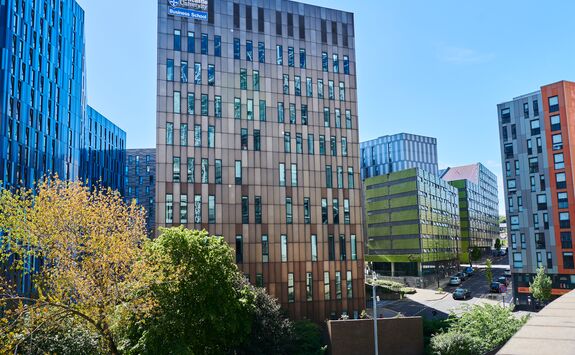
Newcastle University Business School is one of the largest Schools in the University. We have over 4,000 students from over 85 countries. This valuable community extends beyond our current students to include:
- regional, national and international leaders
- over 37,000 alumni in our network, spanning 152 countries
- leading professional and academics who are experts in their field
- businesses and partners in academia
The Business School is the gateway to Newcastle Helix - a landmark 24 acre hybrid city quarter. It brings together researchers, business and communities with the purpose of helping families, communities and cities around the world live healthier, longer, smarter, and easier lives.
We have two buildings – the Business School and the Frederick Douglass Centre. Both offer a range of purpose-build facilities, including.
- computer clusters housing over 120 PCs, plus open IT spaces for laptops
- seven large lecture theatres, plus a 750-seat auditorium – the largest in the University
- 25 seminar and teaching spaces, many with flexible furniture to accommodate learning
- a dedicated Student Hub and Quiet Space, providing a mix of space for group work, individual study, or quiet study
- study pods, some with wall mounted screens, and bookable rooms for working in groups or individually
- a contemporary café, refurbished in 2025
- two dedicated hubs for employability support and events
- a Bloomberg lab with over 20 terminals, so you can experience a real trading room floor
- Experimental and Behavioural Economics Lab, a state-of-the-art research facility for conducting studies in experimental economics and economic psychology
- a flexible conference room with panoramic views across the city and St. James’ Park, which doubles up as a large flexible teaching space
Accessibility
The Business School values individual differences and the diversity this brings. Our buildings are accessible and user friendly. We have a range of adjustments that can support you when moving around our buildings, such as lifts and accessible toilets. We also have gender-neutral toilets in the FDC.
Fees, Funding and Scholarships
Tuition fees for 2027 entry (per year)
As a general principle, you should expect the tuition fee to increase in each subsequent academic year of your course, subject to government regulations on fee increases and in line with inflation.
Depending on your residency history, if you’re a student from the EU, other EEA or a Swiss national, with settled or pre-settled status under the EU Settlement Scheme, you’ll normally pay the ‘Home’ tuition fee rate and may be eligible for Student Finance England support.
EU students without settled or pre-settled status will normally be charged fees at the ‘International’ rate and will not be eligible for Student Finance England support. You may be eligible for a scholarship worth 25% off the international fee. Search our funding database.
If you are unsure of your fee status, check out the latest guidance.
Scholarships
We support our EU and international students by providing a generous range of Vice-Chancellor's automatic and merit-based scholarships. See our searchable postgraduate funding page for more information.
Search for funding and scholarships
Find funding available for your course
What you're paying for
Tuition fees include the costs of:
- matriculation
- registration
- tuition (or supervision)
- library access
- examination
- re-examination
- graduation
Find out more about:
If you are an international student or a student from the EU, EEA or Switzerland and you need a visa to study in the UK, you may have to pay a deposit.
You can check this in the How to apply section.
If you're applying for funding, always check the funding application deadline. This deadline may be earlier than the application deadline for your course.
For some funding schemes, you need to have received an offer of a place on a course before you can apply for the funding.
How to apply
Using the application portal
The application portal has instructions to guide you through your application. It will tell you what documents you need and how to upload them.
You can choose to start your application, save your details and come back to complete it later.
If you’re ready, you can select Apply Online and you’ll be taken directly to the application portal.
Alternatively you can find out more about applying on our applications and offers pages.
Apply Online
Open days and events
Find out about how you can visit Newcastle in person and virtually
Overseas events
We regularly travel overseas to meet with students interested in studying at Newcastle University.
Get in touch
Questions about this course?
If you have specific questions about this course you can contact:
Dr Wee Chan Au - Degree Programme Director
Newcastle University Business School
Telephone: +44 (0) 191 208 1624
Contact Newcastle University Business School
Enquiries
If you've got a question about your application, send us an enquiry via the application portal you applied through.
If you haven't applied yet, or have a general enquiry, you can send your questions via our enquiry form.
Keep updated
We regularly send email updates and extra information about the University.
Receive regular updates by email
Chat to our students
Social Media
Connect with Newcastle University Business School.